
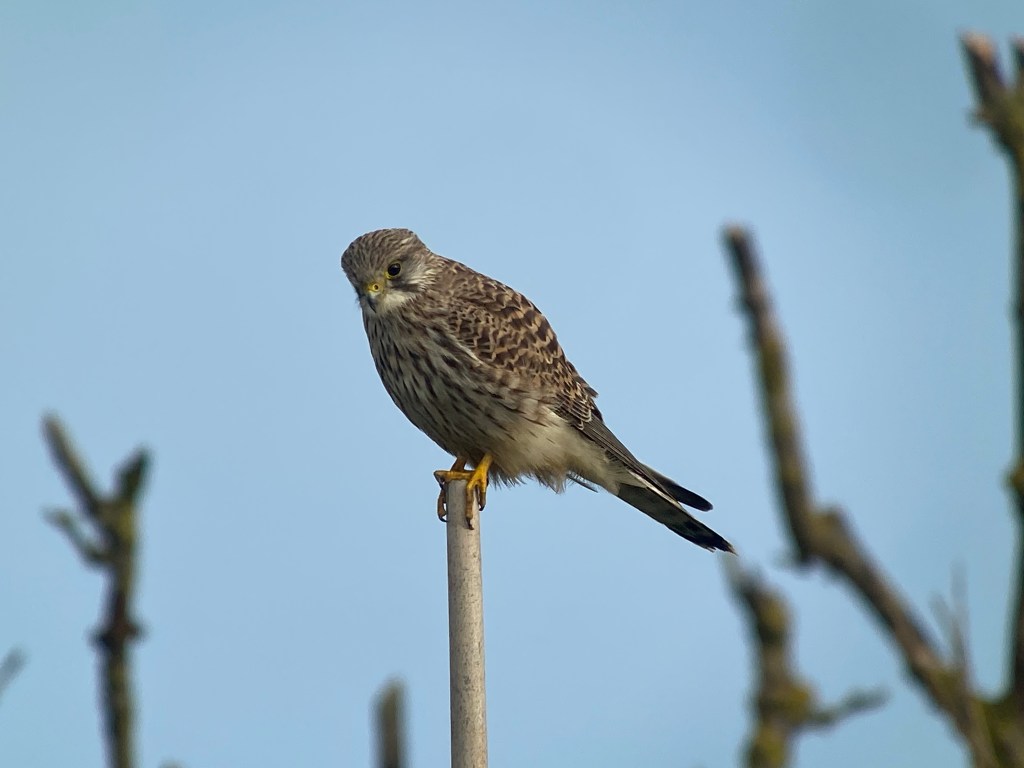
The Common Kestrel (Falco tinnunculus) is a small falcon widely distributed across Europe, Asia, and Africa. Known for its distinctive hovering flight, this bird of prey is often seen hunting for small mammals and insects in open fields, grasslands, and sometimes urban areas.
Key Features
- Size: Typically around 32–39 cm (13–15 in) in length, with a wingspan of 65–82 cm (26–32 in).
- Color: Males have a rusty brown back and wings with dark speckling, a slate-gray head, and a lightly barred tail. Females are more uniformly brown and speckled.
- Eyes: Large, dark eyes with excellent vision, crucial for spotting prey from high above.
Behavior and Diet
Common Kestrels are renowned for their hunting method, hovering in one spot while watching the ground below for movement. They primarily feed on small rodents, such as voles and mice, and sometimes small birds, insects, and even reptiles. They hunt mostly during daylight, relying on their keen eyesight.
Habitat and Nesting
Common Kestrels are versatile in habitat choice, occupying open landscapes, farmland, and even city buildings. They nest in tree hollows, cliff ledges, or old nests abandoned by other birds. They do not typically build nests but lay their eggs directly on these surfaces.
Conservation Status
While the Common Kestrel is still widespread and classified as Least Concern by the IUCN, its numbers are declining in some areas due to habitat loss, pesticide use, and changing agricultural practices.



 Andrew Chick Ecology
Leave a comment