
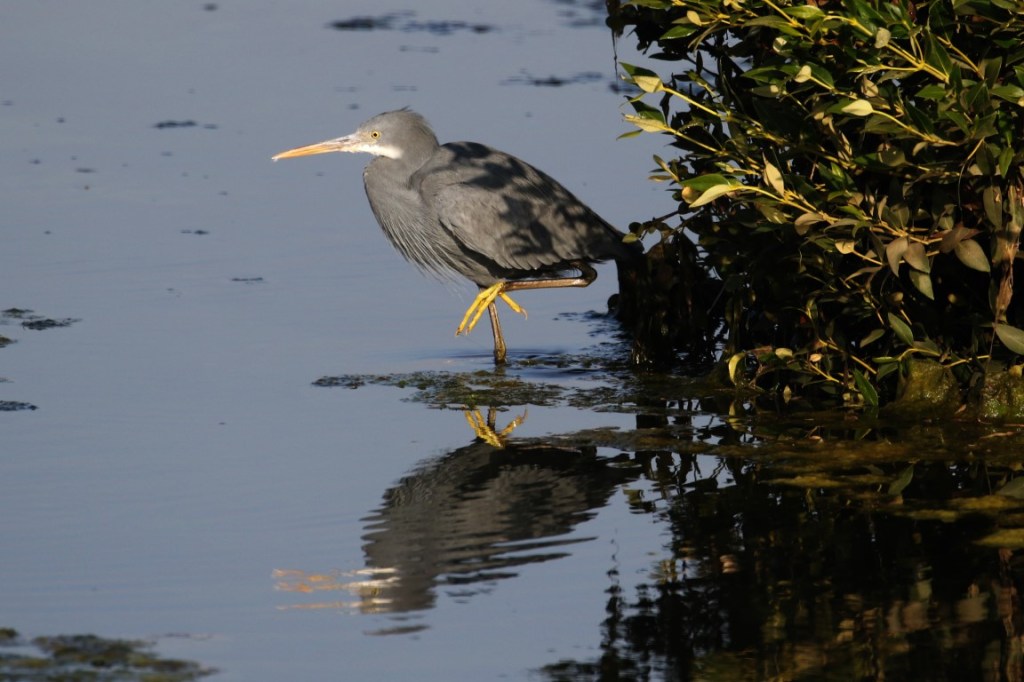
The Western Reef Heron (Egretta gularis), also known as the Western Reef Egret, is a fascinating bird species that exhibits distinct color morphs. These color variations are a notable feature of the species and have been the subject of study in ornithology. The two primary color morphs observed in Western Reef Herons are the dark morph and the light morph, with some intermediate forms occasionally reported.
1. Dark Morph
- Appearance: The dark morph is characterized by a predominantly slate-gray or dark gray plumage. The bird’s entire body, including the head, neck, back, and wings, is covered in this dark coloration.
- Distribution: The dark morph is more common in certain regions, particularly along the coasts of the Red Sea, the Arabian Peninsula, and parts of East Africa.
- Adaptation: The dark plumage may provide camouflage in shaded or rocky coastal environments, helping the bird blend into its surroundings while hunting for fish and other prey.
2. Light Morph
- Appearance: The light morph features a mostly white plumage, similar to other egret species. The bird’s body, wings, and tail are white, though the legs and bill retain the same coloration as the dark morph.
- Distribution: The light morph is more frequently observed in parts of West Africa and some coastal regions of the Indian Ocean.
- Adaptation: The white plumage may offer advantages in open, sunlit environments, such as sandy beaches or shallow waters, where it can blend in with the bright surroundings.
3. Intermediate Morph
- Appearance: Some Western Reef Herons exhibit an intermediate or mixed coloration, with patches of both dark and white feathers. These individuals may have a mottled or piebald appearance.
- Rarity: Intermediate morphs are less common and are thought to result from genetic variation or hybridization between dark and light morphs.
Factors Influencing Color Morphs
- Genetics: The color morphs are genetically determined, with the dark morph being dominant over the light morph in some populations.
- Environment: The distribution of color morphs may be influenced by environmental factors, such as habitat type and predation pressure. For example, darker birds may be more common in rocky or shaded areas, while lighter birds may thrive in open, sandy habitats.
- Geographic Variation: The prevalence of each morph can vary significantly across the species’ range, with some regions dominated by one morph over the other.
Behavioral and Ecological Implications
- Feeding Behavior: Both morphs exhibit similar feeding behaviors, such as stalking prey in shallow waters or along coastlines. However, their coloration may influence their success in different habitats.
- Reproduction: There is no evidence to suggest that color morphs affect mating preferences or reproductive success, as both morphs interbreed freely.
Conservation and Study
- The Western Reef Heron is not currently considered threatened, but habitat loss and environmental changes could impact local populations. Studying color morphs can provide insights into the species’ adaptability and evolutionary history.
In summary, the Western Reef Heron’s color morphs—dark, light, and intermediate—are a striking example of polymorphism in birds. These variations are influenced by genetics, environment, and geography, and they highlight the species’ adaptability to different habitats.




Here is a list of references that you can use to learn more about Western Reef Herons (Egretta gularis). These references include books, scientific articles, and online resources that cover various aspects of the species, including its color morphs, behavior, ecology, and distribution:
Books
- Hancock, J., & Kushlan, J. A. (1984). The Herons Handbook. Harper & Row.
- A comprehensive guide to herons worldwide, including detailed information on the Western Reef Heron.
- del Hoyo, J., Elliott, A., & Sargatal, J. (Eds.). (1992). Handbook of the Birds of the World, Volume 1: Ostrich to Ducks. Lynx Edicions.
- Provides an overview of the Western Reef Heron’s taxonomy, distribution, and behavior.
- Snow, D. W., & Perrins, C. M. (1998). The Birds of the Western Palearctic: Concise Edition. Oxford University Press.
- Includes information on the Western Reef Heron’s range and ecology in the Western Palearctic region.
Scientific Articles
- Kushlan, J. A., & Hancock, J. A. (2005). The Herons. Oxford University Press.
- A detailed monograph on herons, including the Western Reef Heron, with insights into its behavior and ecology.
- Porter, R. F., & Aspinall, S. (2010). Birds of the Middle East. Princeton University Press.
- Covers the distribution and identification of the Western Reef Heron in the Middle East.
- Hafner, H., & Fasola, M. (1992). “The relationship between feeding habitat and colonially nesting Ardeidae.” Colonial Waterbirds, 15(1), 57-63.
- Discusses the feeding ecology of herons, including the Western Reef Heron.
- Kazantzidis, S., & Goutner, V. (1996). “Foraging ecology and conservation of herons in Greece.” Colonial Waterbirds, 19(1), 43-54.
- Explores the foraging behavior and habitat use of herons, including Egretta gularis.
Online Resources
- BirdLife International (2023). Egretta gularis (Western Reef Heron).
- BirdLife International Species Factsheet
- Provides information on the species’ global distribution, population trends, and conservation status.
- eBird (2023). Western Reef Heron (Egretta gularis).
- eBird Species Profile
- Offers sightings, photos, and distribution maps contributed by birdwatchers worldwide.
- IUCN Red List of Threatened Species (2023).Egretta gularis.
- IUCN Red List Entry
- Provides conservation status and threats faced by the species.
- Xeno-Canto (2023). Western Reef Heron (Egretta gularis).
- Xeno-Canto Bird Sounds
- Features audio recordings of the species’ calls and vocalizations.
Field Guides
- Svensson, L., Mullarney, K., & Zetterström, D. (2009).Collins Bird Guide: The Most Complete Guide to the Birds of Britain and Europe. HarperCollins.
- A field guide that includes identification tips for the Western Reef Heron in Europe.
- Sinclair, I., & Ryan, P. (2010).Birds of Africa South of the Sahara. Struik Nature.
- Covers the Western Reef Heron’s presence in African coastal regions.

 Andrew Chick Ecology
Leave a comment