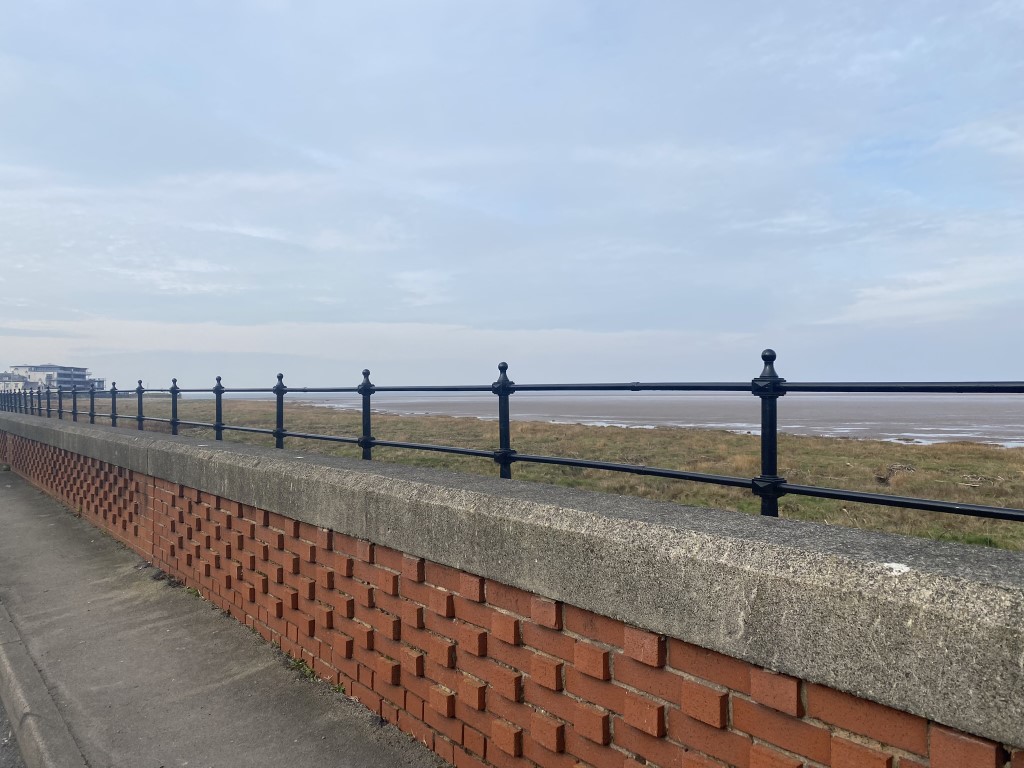
A winter Black Redstart has been a regular sight at Knott End in Lancashire for most of the winter (2024/25), favoring the jetty end of the Esplanade. On 18th February 2025, I observed the bird as it foraged in the ‘gardens’ associated with the ground-floor apartments of the Waterfront apartment block. The individual was identified as a first-winter male.
A first-winter male Black Redstart exhibits a mix of juvenile and adult plumage characteristics, displaying early signs of male coloration while retaining a subdued, somewhat female-like appearance. The overall color is mostly brownish-grey, often darker and sootier in tone compared to females. The breast and underparts are dusky grey-brown, occasionally with a slight warm tint. The wings are dark brown with pale fringes on the coverts and flight feathers, creating a slightly scaly effect. The back and mantle are brownish-grey, sometimes darker than in females.
One of the most distinctive features is the rump and tail, which are a warm rufous-orange with dark central feathers, a hallmark of the species. The head and face are generally darker than in females, often with a slight greyish wash, though not as deep black as in adult males. The bill and legs are black. As the bird molts into its adult plumage by the following spring, black feathers will begin to appear, giving it a darker, more male-like appearance.
Sadly the bird kept it’s distance, and I didn’t get any great images….
The Black Redstart is a rare but regular winter visitor to northwest England, particularly in urban and industrial areas. Here’s a summary of its winter status in the region:
Distribution: During winter, Black Redstarts are most often found in coastal areas, ports, and urban environments with suitable habitat, such as abandoned industrial sites, warehouses, and buildings. In northwest England, they are occasionally reported in cities like Liverpool and Manchester, as well as in coastal towns.
Numbers: They are scarce in winter, with only a small number of individuals typically recorded. The species is more common in southern and eastern England during this season.
Habitat: They prefer areas with sparse vegetation, rocky terrain, and man-made structures, which mimic their natural cliff and rocky habitat.
Conservation Status: The Black Redstart is a UK Biodiversity Action Plan (BAP) species due to its rarity and declining breeding population. Winter sightings are valuable for monitoring its status.

 Andrew Chick Ecology
Leave a comment