
Photo: Drake Mandarin at Bowness, Windermere (c) Andrew Chick
The Mandarin Duck is a non-native species in England, originally from East Asia. Introduced in the 18th century as an ornamental bird for private collections and parks, some individuals eventually escaped or were released, leading to the establishment of small feral populations. Today, the species maintains a small but stable presence in England, particularly in wooded areas with ponds, lakes, or rivers. Key locations include parts of Surrey, Berkshire, and the Cotswolds.
Though not a native species, the Mandarin Duck is protected under the Wildlife and Countryside Act 1981, making it illegal to kill, injure, or capture them from the wild. However, it is not considered a conservation priority. Its ecological impact in England is minimal, as it does not significantly compete with native waterfowl due to its preference for different habitats and nesting sites, such as tree cavities.
Breeding occurs successfully in England, particularly in areas with suitable habitat. Nesting takes place in tree holes near water, and shortly after hatching, ducklings make their way to the ground. While the population remains relatively small, the species is widespread in southern and central England, with occasional sightings in other parts of the UK.
For those interested in spotting Mandarin Ducks, wooded areas with water bodies in southern England provide the best chances. Males are particularly striking, with their vibrant and colorful plumage making them easy to identify.
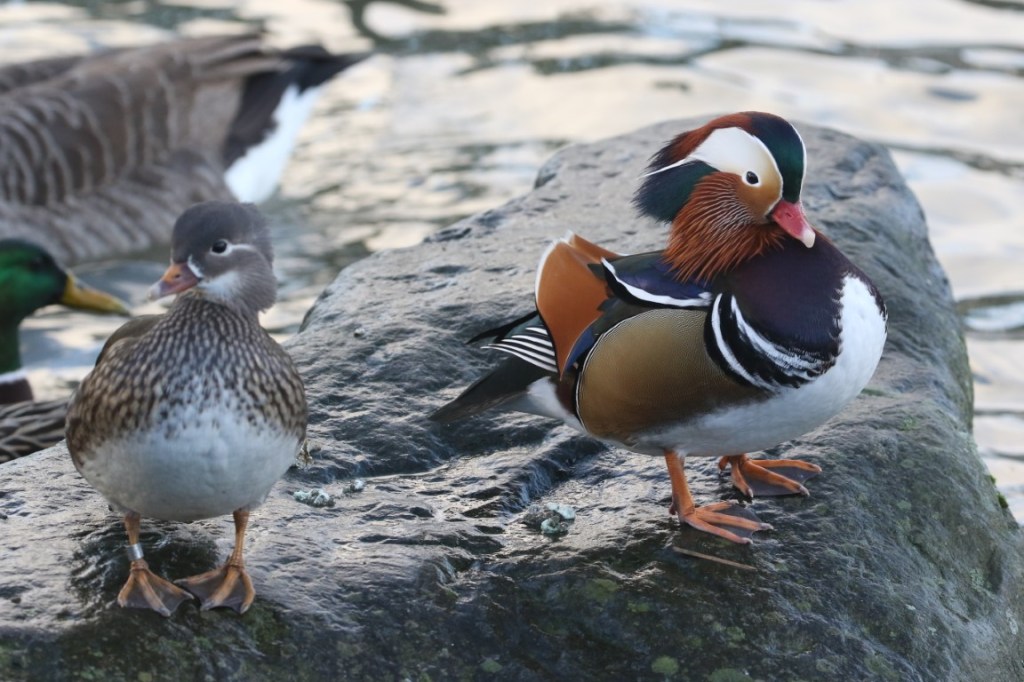
Photo: Pair of Mandarins at Bowness, Windermere, note the female has a BTO metal ring! (c) Andrew Chick
Mandarin ducks are not long-distance migrants like some other bird species. In their native range across East Asia, including China, Japan, Korea, and eastern Russia, they are generally resident or partially migratory. While some populations remain in the same area year-round, others move short distances seasonally.
In milder climates, particularly in the southern parts of their range, Mandarin ducks tend to stay in one location throughout the year, provided there is a consistent food supply and suitable habitat. In contrast, populations in northern regions, where winters can be harsh, may migrate short distances to more favorable conditions. This typically involves moving from higher altitudes or northern latitudes to lower elevations or more temperate areas.
In regions where they have been introduced, such as the UK and parts of Europe, Mandarin ducks generally do not migrate. These populations have adapted to local conditions and remain in the same area year-round, particularly where suitable habitats like wooded ponds, lakes, and rivers are available.
During the breeding season, Mandarin ducks prefer wooded areas near water bodies, nesting in tree cavities often high above the ground. In the non-breeding season, they may expand into a wider range of habitats, including open water bodies, though they still favor areas with tree cover.
Their movements are influenced by factors such as food availability and weather conditions. They feed on a variety of plant matter, seeds, insects, and small aquatic creatures, and if food becomes scarce, they may relocate to more resource-rich areas. Severe weather, particularly freezing temperatures that ice over water bodies, can also trigger short-distance movements in search of more favorable conditions.
Mandarin Ducks in Cumbria
In Cumbria, Mandarin ducks disappearing (or certainly get very scarce) in winter and returning in spring suggests seasonal movement rather than true migration. Several factors could explain this pattern:
- Harsh Winter Conditions – Mandarin ducks prefer wooded lakes and rivers, but if these water bodies freeze over, food sources like aquatic vegetation, seeds, and invertebrates become scarce. They may move to lower-altitude areas or regions with milder conditions where water remains unfrozen.
- Food Availability – During winter, natural food sources in Cumbria’s woodlands may decline. Ducks could move to areas with better feeding opportunities, such as lowland wetlands, sheltered lakes, or even urban parks where supplementary feeding occurs.
- Shelter and Roosting Sites – While Mandarins nest in tree cavities, winter conditions may make certain wooded areas less suitable for roosting. They may relocate to areas with denser tree cover or more stable shelter before returning in spring for breeding.
- Partial Migration Behavior – In their native range, some Mandarin populations move short distances between breeding and wintering sites. The Cumbria population may exhibit similar behavior, shifting to more favorable wintering grounds before returning to their breeding areas in spring.
- Influence of Local Climate and Elevation – Cumbria has upland and lowland areas. Mandarin ducks might move from colder, upland habitats to more temperate lowland regions before returning when conditions improve.
Their return in spring aligns with the breeding season when they seek suitable wooded habitats near water to nest. If the same pattern is observed annually, it suggests a predictable seasonal movement based on environmental conditions.
The small breeding population of Mandarin ducks in the Lake District and northern Cumbria continues to persist, though these strikingly colourful birds can often be overlooked. Despite their vibrant plumage, they are remarkably unobtrusive, typically inhabiting wooded lakesides, ponds, and rivers. Although they are an introduced species, most people undoubtedly enjoy the sight of this delightful bird.
The 2023 Cumbria Bird Report notes, there appears to have been no confirmed proof of breeding, despite an increase in records from various sites and the presence of pairs during the appropriate breeding season. This suggests that breeding may have occurred but went undetected. Mandarin ducks were observed at several locations, including Castle Carrock Reservoir, Borrans Park near Ambleside, Harrington Reserve, Brockhole Visitor Centre (Windermere), Rusland Pool, Wray Castle, Killington, Grange-over-Sands, and Foulshaw Moss.
Notably, Derwentwater remained a key site for sightings, where the species has bred in recent years. Up to five individuals were seen throughout much of the year, with numbers rising to 15 in December. Additionally, three pairs were spotted feeding in Stagscale near Lanercost in May, an area where they have also bred in the past. These observations highlight the species’ continued presence in the region, even if breeding activity remains elusive.
Why are there so few records of breeding Mandarin Ducks?
Obtaining confirmed breeding records of Mandarin ducks can be challenging for several reasons, largely due to their behavior, habitat preferences, and the secretive nature of their nesting habits. The key factors that make it difficult to confirm breeding include their nesting habits, secretive behavior, short nesting period, challenges in monitoring, lack of distinctive breeding signs, sensitivity to human disturbance, and limited research and monitoring efforts.
Mandarin ducks typically nest in tree cavities, often high above the ground, which are well-hidden and difficult to locate, especially in dense woodland areas. They prefer secluded, wooded areas near water bodies, which are often less accessible to observers, making it harder to monitor their nesting activities closely. Despite their colorful plumage, Mandarin ducks are remarkably unobtrusive and tend to avoid human activity, particularly during the breeding season when they are focused on nesting and raising their young. Females spend a significant amount of time incubating eggs and caring for ducklings within the nest, reducing the chances of being observed.
The nesting period is relatively short, and once the ducklings leave the nest, they quickly move to water bodies. This brief window of opportunity makes it difficult for observers to catch them in the act of breeding. Additionally, many of the habitats preferred by Mandarin ducks, such as dense woodlands and remote water bodies, are not easily accessible, limiting the ability of birdwatchers and researchers to conduct thorough surveys. The natural camouflage of the ducks and their nests, combined with the dense foliage of their habitats, further complicates spotting them.
Unlike some bird species that exhibit clear breeding behaviors or build conspicuous nests, Mandarin ducks do not leave many obvious signs of breeding. This lack of distinctive indicators makes it harder to confirm breeding without direct observation. Furthermore, Mandarin ducks are sensitive to human disturbance, and frequent visits by observers to potential nesting sites can disrupt their breeding activities, causing them to abandon nests or become even more secretive. In some regions, there may also be limited dedicated research or monitoring efforts focused on Mandarin ducks, resulting in fewer confirmed breeding records.
In conclusion, the combination of their secretive nesting habits, preference for secluded and dense habitats, and the challenges of monitoring these areas all contribute to the difficulty in obtaining confirmed breeding records for Mandarin ducks. Despite these challenges, continued observation and research can help improve our understanding of their breeding ecology and contribute to more accurate records.

 Andrew Chick Ecology
Leave a comment