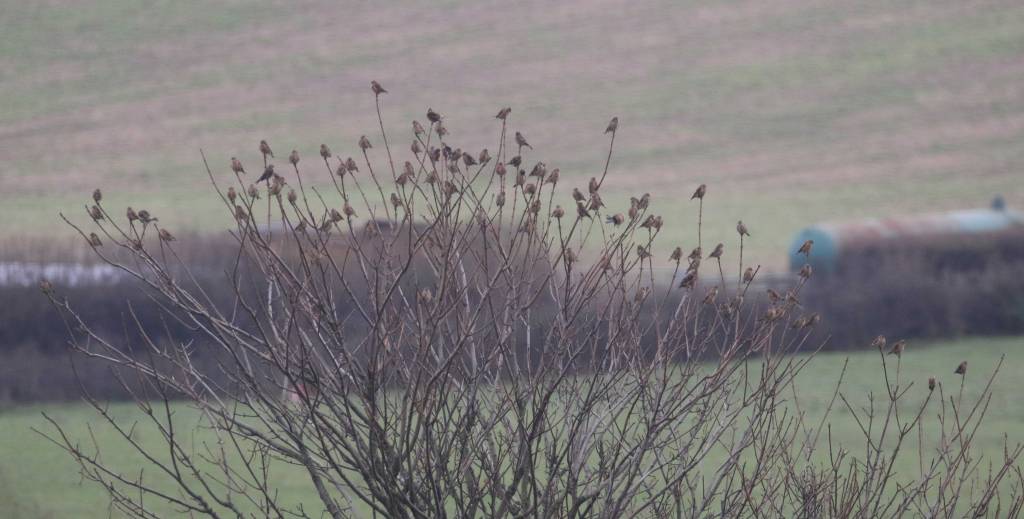
Take a guess at how many linnets are in this tree… (the answer is at the bottom of the page)..
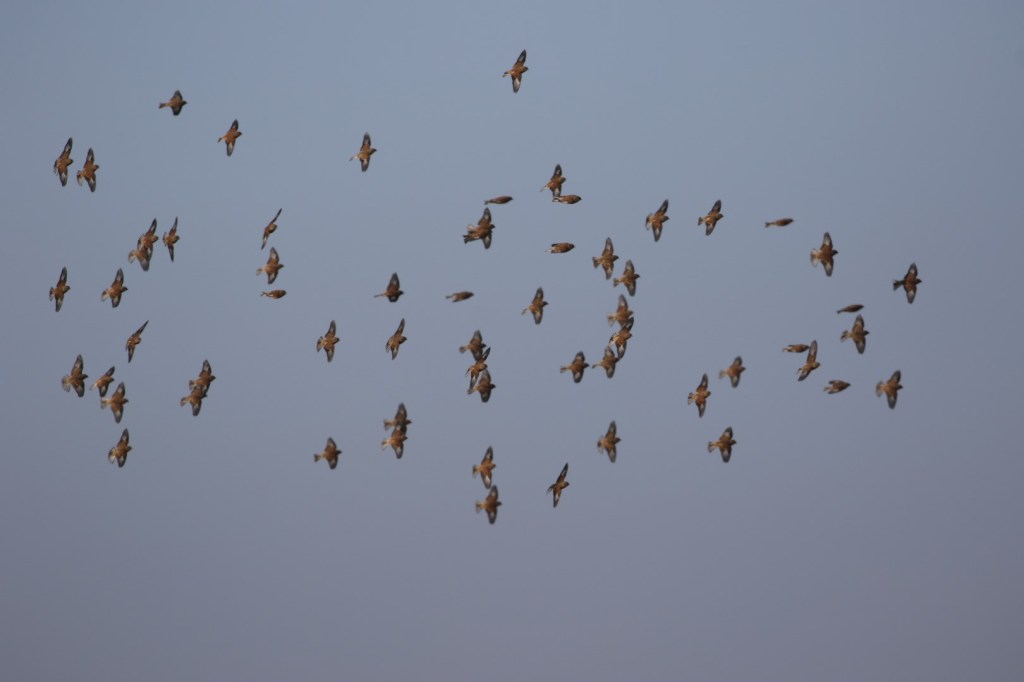
The linnet is a small, attractive finch often overlooked due to its subtle plumage and preference for open landscapes. Males in their breeding plumage are distinctive, with a rosy-pink flush on the breast and forehead, set against warm brown upperparts and a streaked back. Females lack the red hues but share the same compact shape, fine bill, and forked tail. In all plumages, linnets have a noticeably bounding flight and a sweet, rippling song, often delivered from a hedgerow or wire. Their soft, twittering calls can be a key aid in identification, particularly when birds are seen in flight.
In England, the linnet has experienced a significant decline, leading to its classification as a Red List species on the Birds of Conservation Concern (BOCC) assessment. Once common across farmland and heathland, habitat loss, agricultural intensification, and reduced seed availability have all contributed to population decreases. The decline has been particularly pronounced in areas where traditional mixed farming has been replaced with large-scale monoculture, limiting food resources and nesting opportunities.
Despite its national decline, the linnet remains a widespread, though increasingly localised, species in Cumbria. The county’s coastal fringes, lowland farmland, and upland fringes still support good numbers, particularly in areas where scrub, hedgerows, and weedy field margins provide both food and nesting sites. During the breeding season, linnets are often found in gorse thickets, hedgerows, and scrubby grasslands, where they weave delicate nests hidden among dense vegetation.
In winter, linnets become more sociable, forming flocks that can number in the hundreds. These gatherings are often seen in stubble fields, saltmarshes, and coastal dunes, where they feed on the seeds of plants such as thistles, docks, and charlock. Their flocks frequently mix with other finches, including twite and goldfinches, and can be highly mobile, moving across the landscape in search of the best feeding grounds.
Breeding takes place in the warmer months, with nesting beginning in April and continuing into late summer. Linnets favour low, dense cover such as hawthorn hedgerows, gorse patches, or bramble thickets, often close to farmland or rough grassland. Their nests are neatly woven cups of twigs, grasses, and moss, lined with soft materials such as wool or feathers. They typically raise two broods in a season, feeding their young on a diet of regurgitated seeds.
Though linnets remain a characteristic bird of open countryside, their continued presence depends on sympathetic land management. The retention of traditional hedgerows, the encouragement of wildflower-rich margins, and the preservation of scrubby landscapes will all play a crucial role in securing the future of this once-abundant species.
And, there are 104 birds in the photograph (taken on farmland near Ulverston in Southern Cumbria)


 Andrew Chick Ecology
Leave a comment