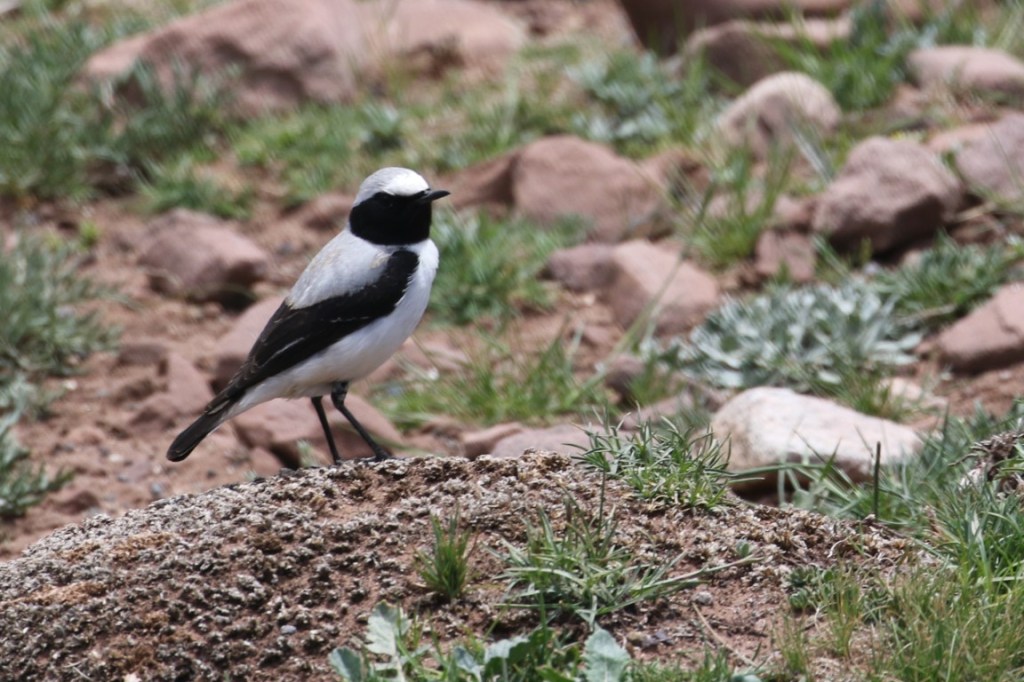
The Atlas Wheatear is a recently split species from the formerly widespread Northern Wheatear complex and is now recognized as a distinct species endemic to the mountainous regions of North Africa. Identification of the Atlas Wheatear involves noting its bold plumage and upright posture. Males in breeding plumage exhibit a striking contrast of black face and throat, white underparts, and a pale crown and back, with a distinctive white rump and black tail pattern characteristic of wheatears. Females and non-breeding males are duller, showing more subdued brown and gray tones, but still retain the characteristic wheatear tail pattern.
This species inhabits open, rocky, and often barren high-altitude environments, primarily in montane and subalpine zones. It prefers areas with sparse vegetation, scattered rocks, and short grasses, often near cliffs, scree slopes, or alpine meadows. During the breeding season, it is typically found above 1,800 meters, where it nests in crevices or among stones. The Atlas Wheatear is adapted to cold, wind-swept habitats where few other passerines occur.
Geographically, the Atlas Wheatear is restricted to the Atlas Mountains of Morocco, Algeria, and Tunisia. It is a summer breeder in these regions and migrates south to the Sahel zone of sub-Saharan Africa during the non-breeding season. Within the breeding range, it can often be seen perched conspicuously on rocks, scanning for insects, or engaging in its typical ground-feeding behavior, characterized by short hops and frequent tail flicking.




 Andrew Chick Ecology
Leave a comment