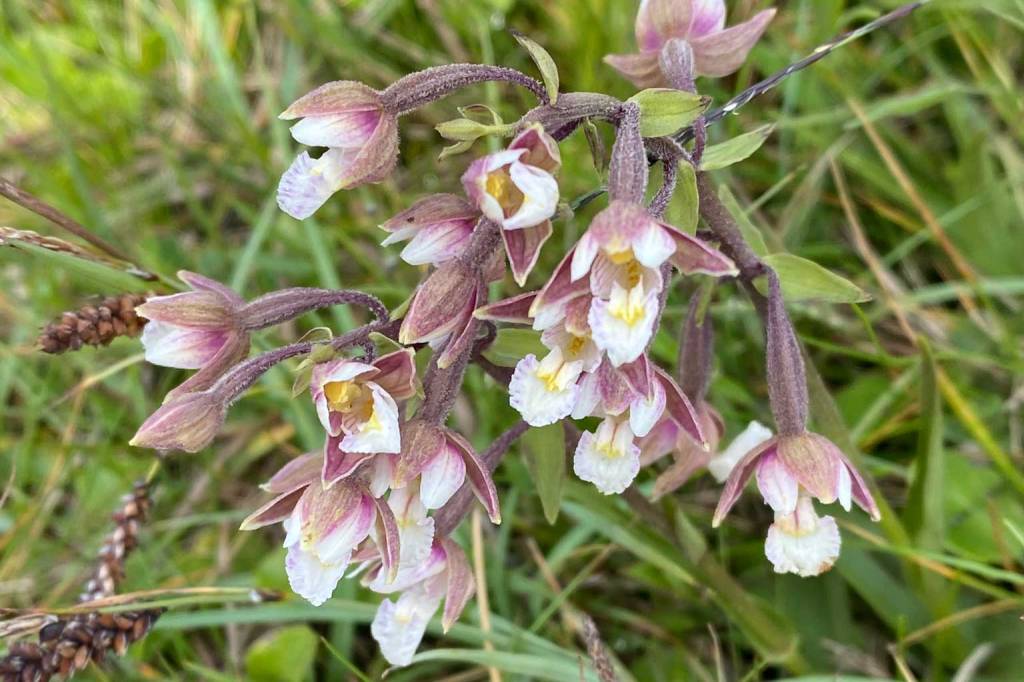
Photograph from near Millon in Cumbria (c) Andrew P. Chick 2025
The Marsh Helleborine (Epipactis palustris) is one of Britain’s most elegant native orchids, admired not only for its beauty but also for its ecological significance. Found across parts of Europe and temperate Asia, this plant has a particular stronghold in the UK in lime-rich fens, damp meadows, and marshes, where conditions support its unique life cycle.
Appearance and Identification
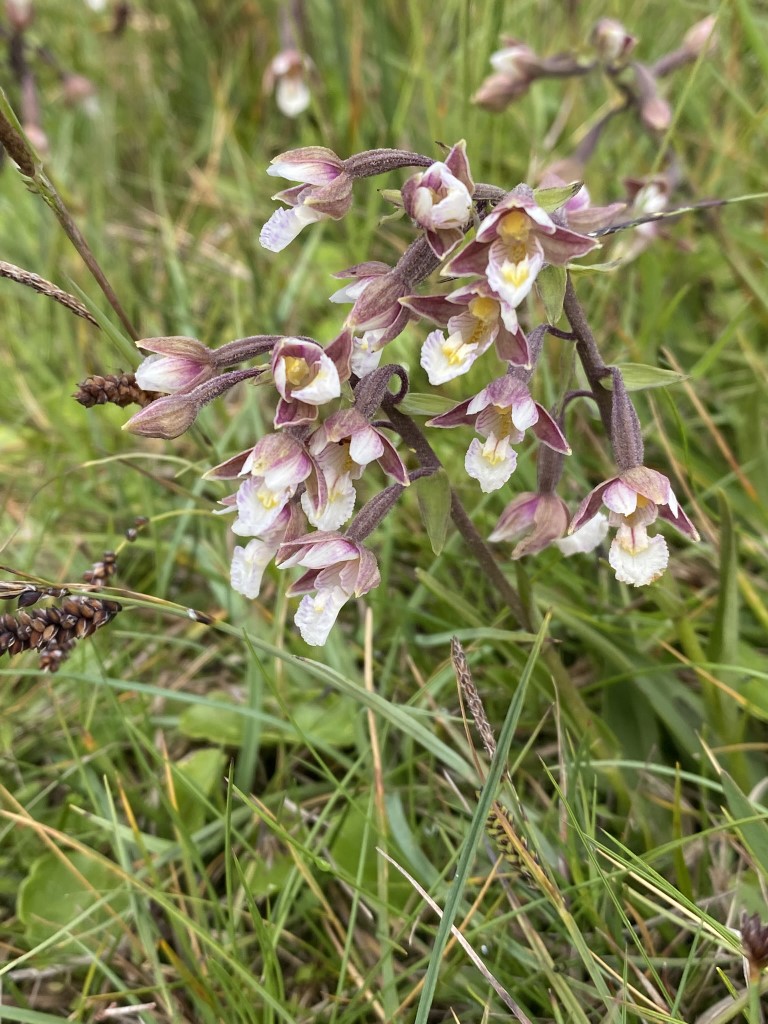
Standing 20 to 50 cm tall, the Marsh Helleborine produces slender, upright stems from a creeping rhizome. Its leaves are narrow and grass-like, arranged alternately up the stem. The flowers, which appear from late June to August, are what truly set this orchid apart. Each spike bears up to 20 delicate, nodding flowers with pink to purplish outer sepals and petals, and a white lip intricately veined with red. The lip is divided into two parts: a small, upturned central lobe and a larger flat base, often with a slight frill.
The flowers are lightly scented and attract a variety of pollinators, particularly bees and hoverflies. Their pollination mechanism is subtle and fascinating, involving a temporary trapping of the insect to ensure pollen transfer.
Habitat and Distribution
True to its name, the Marsh Helleborine thrives in damp, base-rich soils—particularly in calcareous fens, dune slacks, and marshy grasslands. It is often found in association with other lime-loving plants such as Carex species (sedges), Phragmites australis (common reed), and various mosses.
In the UK, the species has a patchy but locally abundant distribution, with strongholds in East Anglia, South Wales, and parts of northern England. It is a species sensitive to changes in hydrology and nutrient status, and therefore its presence is often an indicator of high-quality wetland habitats.
For Cumbria see https://www.cumbriabotany.co.uk/the-flora-of-cumbria-recording-group/flora-distribution-maps/#Epipactis_palustris
Conservation and Threats
Despite being listed as Least Concern on the IUCN Red List globally, the Marsh Helleborine is considered a species of conservation interest in the UK due to habitat loss and degradation. Its reliance on traditional, low-intensity land management—such as grazing and seasonal flooding—makes it vulnerable to drainage, agricultural intensification, and abandonment of old pasture systems.
In some places, populations have declined due to eutrophication (nutrient enrichment), which allows more aggressive plant species to outcompete delicate fen specialists like the helleborine. Conversely, inappropriate afforestation or overgrazing can also negatively affect its habitat.
Fortunately, where wetland restoration projects have been implemented, this orchid has sometimes shown a remarkable capacity to re-establish, provided that the right hydrological and soil conditions are restored.
Cultural and Scientific Interest
The Marsh Helleborine has long fascinated botanists and naturalists. Its relatively short flowering season adds to its allure, drawing orchid enthusiasts keen to glimpse its blooms in their natural setting. The genus Epipactis is also of scientific interest due to its range of reproductive strategies—some species being self-pollinating, others dependent on specific insects.
This species in particular demonstrates a mutualistic relationship with mycorrhizal fungi in its roots, a common trait among orchids. The fungus aids in nutrient uptake in poor soils, while the plant provides carbohydrates in return—a delicate relationship that makes the species almost impossible to transplant or cultivate without specialist knowledge.
Conclusion
The Marsh Helleborine is more than just a beautiful wildflower; it is a flagship species for healthy, calcareous wetland ecosystems. Its continued presence reflects the survival of some of Britain’s most biodiverse and threatened habitats. Conservation efforts that protect and restore such landscapes not only benefit this orchid but support a wide range of rare flora and fauna. For those lucky enough to find it in bloom, Epipactis palustris offers a quiet reminder of nature’s resilience—and its fragility.

 Andrew Chick Ecology
Leave a comment