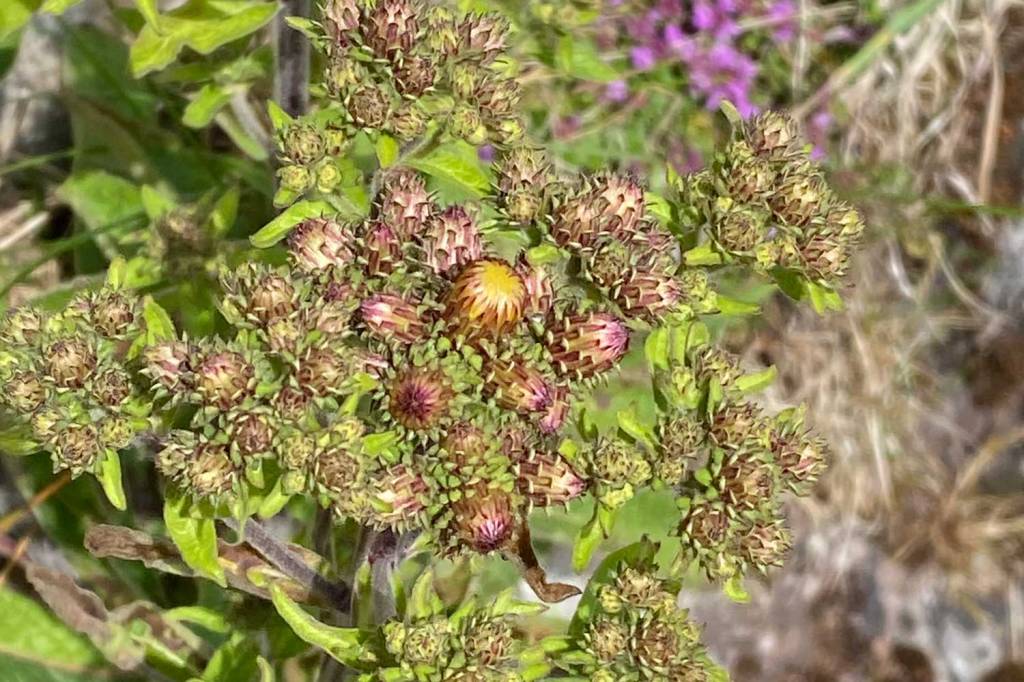
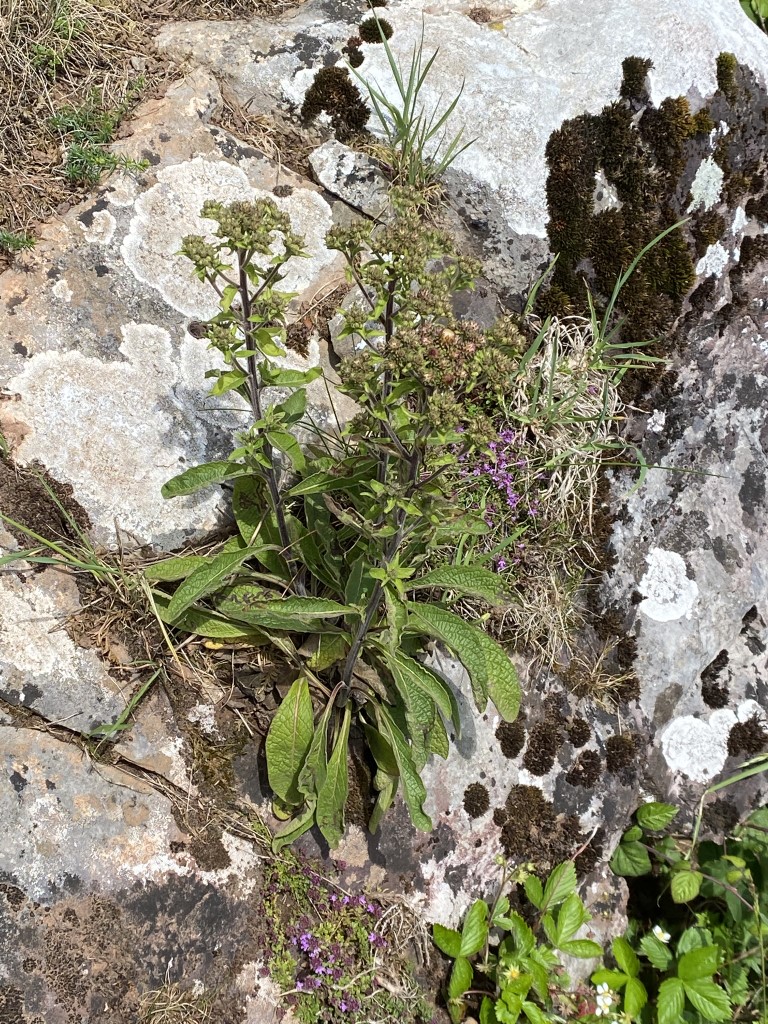
Ploughman’s-spikenard (Inula conyzae), also known as Inula britannica in some older texts, is a modest yet distinctive member of the daisy family (Asteraceae) found in dry, grassy habitats across southern and central Britain. Though not a showy plant, it has a quiet charm and a fascinating ecological role in the landscape.
Appearance
This perennial herb grows up to 1 metre tall and is typically unbranched, with a rather upright and wiry appearance. Its grey-green leaves are narrow and somewhat rough to the touch, with a faintly aromatic scent when crushed. From late summer into early autumn (July to September), it produces small, yellow flower heads clustered at the top of the stem. These flowers are less flamboyant than other members of the daisy family but have a distinctive ragged look and a faintly sweet, musky scent.
Habitat and Distribution
Ploughman’s-spikenard favours dry, calcareous soils and is most often found on chalk or limestone grasslands, railway embankments, old quarries, and open scrubland. In the UK, it is more commonly encountered in the southern half of the country, particularly in areas with unimproved or semi-natural grassland.
Ecology
Although not a major nectar source, its flowers are visited by a range of late-flying insects, including bees, hoverflies, and butterflies. The plant also serves as a foodplant for the larvae of several moth species. Its role in supporting invertebrates makes it a valuable, if understated, component of dry grassland communities.
Etymology and History
The common name ‘Ploughman’s-spikenard’ is thought to refer to the plant’s historic use among rural workers, possibly as a mildly fragrant herb. The term ‘spikenard’ links it—somewhat fancifully—to the biblical perfume of Nardostachys jatamansi, though the two are not botanically related.
Conservation
Though still relatively widespread, Inula conyzae is sensitive to habitat loss and the decline of traditional grassland management. As old meadows and calcareous pastures continue to disappear under development or intensive farming, the plant’s future depends on the protection and restoration of these dry, species-rich habitats.
Final Thoughts
Ploughman’s-spikenard may not grab attention like more flamboyant wildflowers, but it is a quietly important species, both culturally and ecologically. For those walking the downlands and open hillsides in late summer, its slender stems and yellow tufts are a subtle reminder of the richness of Britain’s traditional grasslands.



 Andrew Chick Ecology
Leave a comment