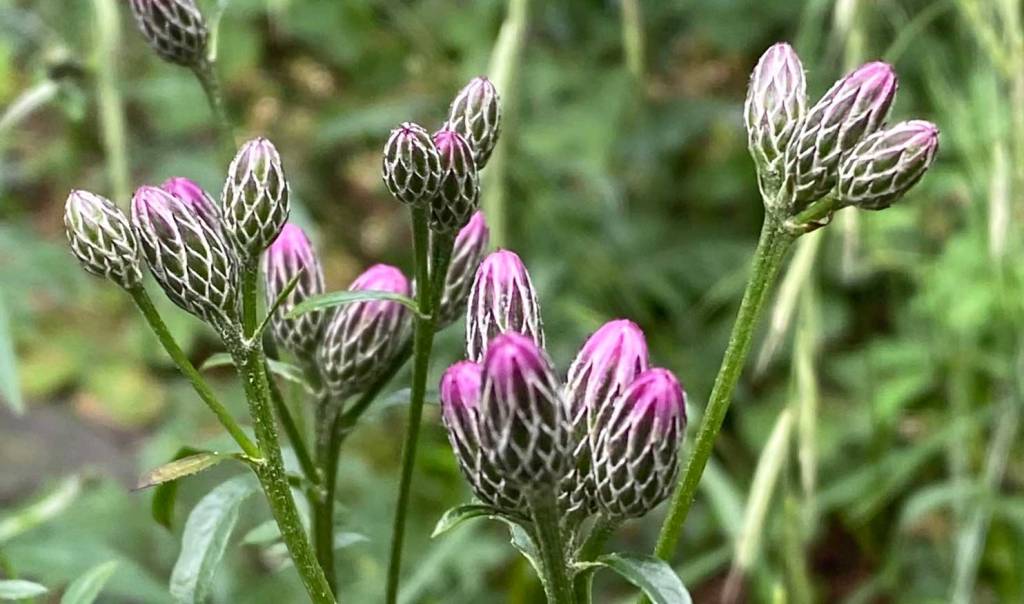
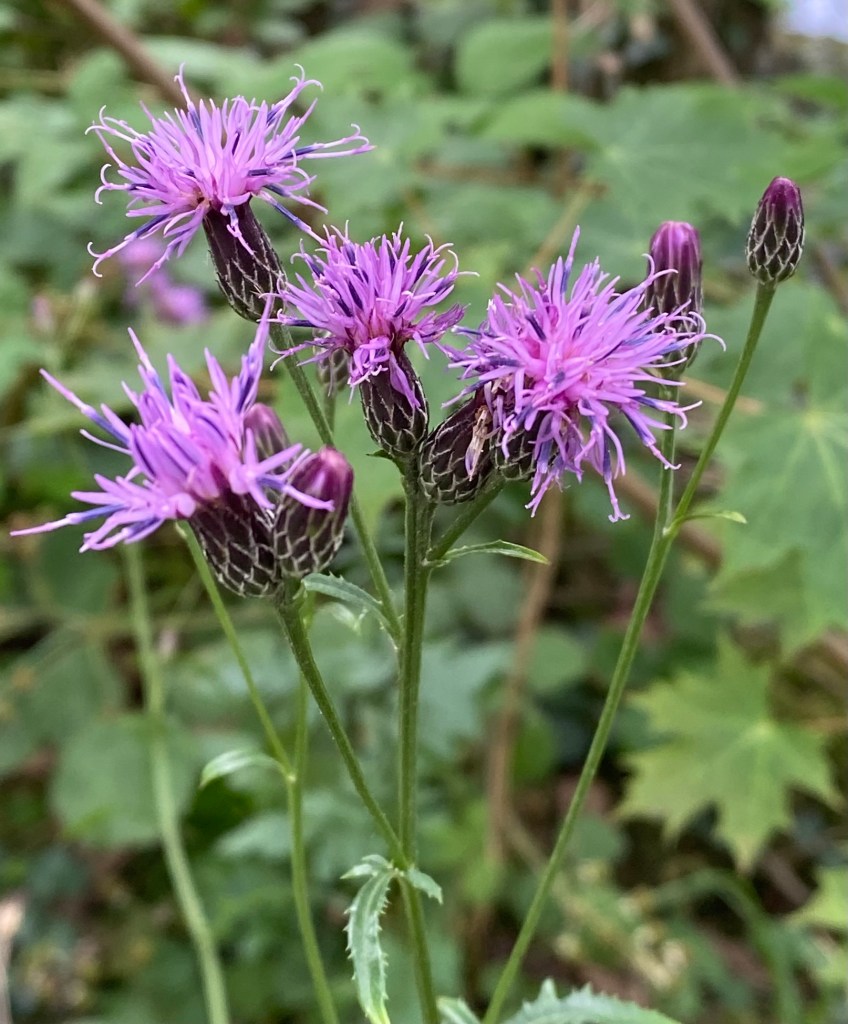
Saw-wort (Serratula tinctoria) is a distinctive perennial wildflower found in damp meadows, grassy woodland rides, and unimproved pastures, particularly on acidic or neutral soils. It is easily recognised by its purple, thistle-like flower heads and finely serrated, lance-shaped leaves—hence the name “saw-wort.” Blooming from July to September, it provides a valuable late-summer nectar source for a variety of pollinators, including bees and butterflies. Historically, it was used as a source of yellow dye, and although now considered locally scarce, it can still be found in pockets of traditional, low-intensity farmland or nature reserves managed for botanical diversity.
In Cumbria it is a species with a notably patchy distribution, it is locally frequent from Sebergham northwards to Bewcastle, with additional strongholds on the Asby–Orton limestone and along the shores of Ullswater and Windermere, but remains scarce or absent elsewhere in the region. It occupies a wide range of habitats, including damp, often calcareous or base-rich roadside verges, open woodland, herb-rich hay meadows, and coarse grassland—often alongside Sanguisorba officinalis, Cirsium palustre, and Carex species—as well as dry limestone grassland and wooded, stony, or rocky lake shores. It is a characteristic component of lakeside plant communities, typically occurring with Thalictrum minus, Trollius europaeus, and Galium boreale, although its apparent restriction to Windermere, Bassenthwaite, and Ullswater remains puzzling. Despite its relative abundance in parts of northern Cumbria, it is notably rare just across the Border in southern Scotland.
Photos by Andrew Chick from Windermere, Cumbria.

 Andrew Chick Ecology
Leave a comment