
Common ragwort (Jacobaea vulgaris, formerly Senecio jacobaea) is one of Britain’s most debated wildflowers. To some, it is a toxic weed that poses a threat to grazing animals; to others, it is a vital component of native ecosystems and an unsung hero for pollinators. Found throughout the UK in meadows, roadsides, grasslands, and disturbed ground, ragwort’s golden-yellow flowers are impossible to miss from mid-summer into early autumn.
Despite its reputation for toxicity, due to the presence of pyrrolizidine alkaloids that can harm livestock if ingested in quantity, common ragwort plays an essential role in supporting insect life. It is, in fact, one of the most significant nectar sources in the late summer landscape. Studies by the UK’s Buglife organisation and other entomological surveys have shown that ragwort supports well over 150 insect species, including around 30 that rely on it almost exclusively. Among these is the striking cinnabar moth (Tyria jacobaeae), whose black and red adult form and tiger-striped larvae are familiar sights on flowering plants during July and August.
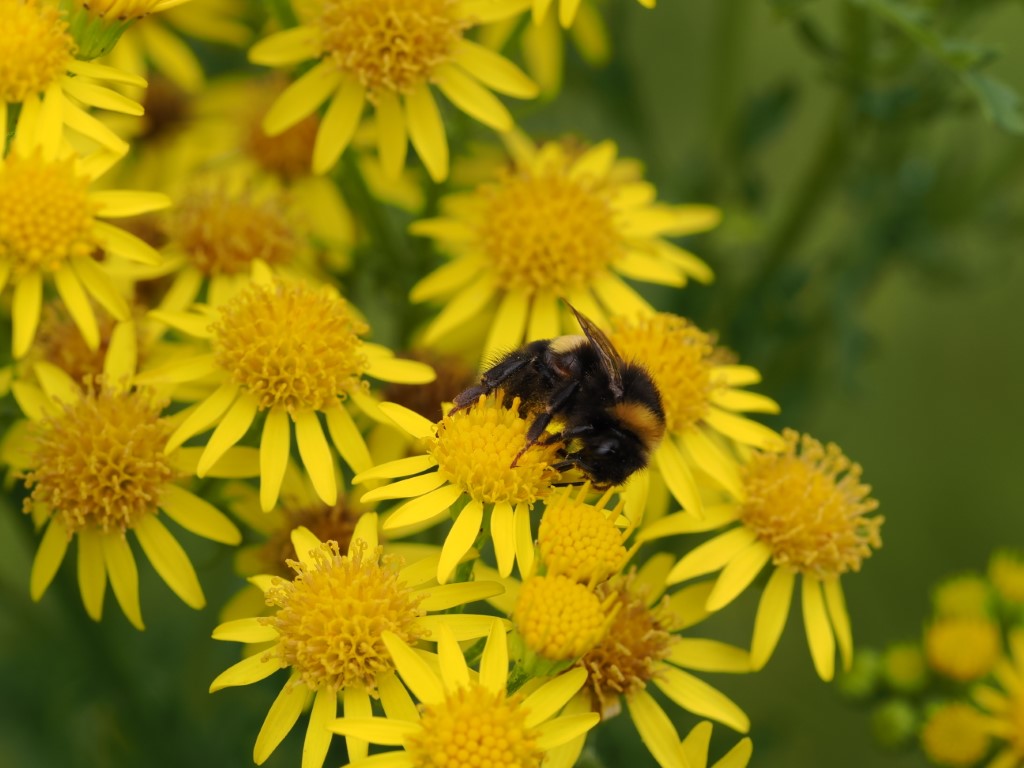
Ragwort’s ecological value lies not only in its abundance of flowers but also in the structure and timing of its bloom. Flowering when other nectar sources begin to decline, ragwort offers a critical lifeline to bees, butterflies, hoverflies, and solitary wasps during a late-summer gap. Pollinators such as the red-tailed bumblebee (Bombus lapidarius), various species of hoverfly including Eristalis tenax, and small tortoiseshell (Aglais urticae) and peacock butterflies (Aglais io) are regular visitors to its daisy-like blooms.
Its open, composite flower heads are especially well-suited to short-tongued bees and flies, while its longevity through dry spells and disturbed sites makes it a dependable part of many insect lifecycles. For specialists like the ragwort plume moth (Calyciphora albodactylus) and the scarce picture-winged fly (Campiglossa plantaginis), its presence is even more critical. Without ragwort, these species would disappear entirely from local ecosystems.
Of course, the plant’s toxic properties cannot be ignored, especially where it grows in or near grazing land. However, it is worth noting that livestock generally avoid fresh ragwort due to its bitter taste, and the greatest risk comes from dried material in hay. With proper land management and an understanding of the plant’s lifecycle, it is possible to control ragwort in sensitive areas while preserving its value for biodiversity elsewhere.
Ragwort has long been present in the British countryside, and in recent decades, conservationists have argued that its ecological role deserves greater recognition. The UK’s Ragwort Code, developed by DEFRA, encourages a balanced approach: controlling ragwort in high-risk areas while allowing it to thrive in places where it poses no danger but offers high wildlife value.
Ultimately, common ragwort is a paradoxical plant: poisonous to some, precious to many. To view it solely as a threat is to overlook its importance as a keystone species for insects. In an age of pollinator decline, when habitat loss and climate change are putting increased pressure on wildlife, ragwort stands tall, literally and metaphorically, as a reminder that even the most maligned species may be vital to the web of life.
Rethinking our relationship with ragwort doesn’t mean ignoring genuine risks, but it does mean recognising that its golden blooms are not just weeds, they’re lifelines.

 Andrew Chick Ecology
Leave a comment