
The plant Asplenium trichomanes, better known as Maidenhair Spleenwort, is a graceful and easily recognisable fern, often found in the quiet crevices of walls and rocks across much of the UK. Despite its delicate appearance—arching fronds of small, rounded leaflets on wiry black stalks—it is a surprisingly hardy species, adapted to colonising the narrowest cracks in stonework and cliffs where few other plants can thrive.
Subspecies and Differences
Maidenhair Spleenwort isn’t a single uniform plant but comprises several subspecies, each with distinct ecological preferences. The most widely recognised in the UK are:
- Asplenium trichomanes subsp. trichomanes: This subspecies prefers acidic substrates, growing naturally on non-calcareous rocks such as sandstone and granite. It is more typical of upland areas and natural crags.
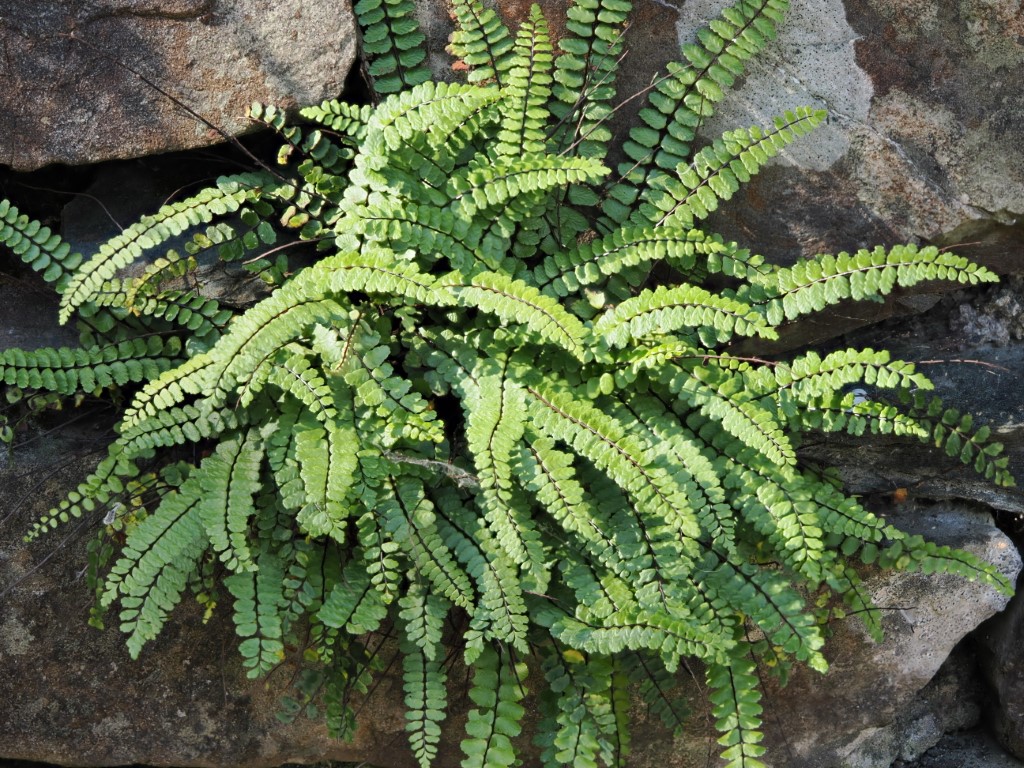
- Asplenium trichomanes subsp. quadrivalens: This is the form most frequently encountered in man-made habitats, especially on lime-rich walls and buildings. It is well adapted to mortar, thriving in crevices of calcareous stonework, and also occurs on natural limestone outcrops and pavements. One distinguishing feature is its tetraploid chromosome count, which gives it a more robust appearance compared to its diploid relatives.
- Asplenium trichomanes subsp. pachyrachis: Less common, this subspecies is also associated with calcareous environments, including walls and limestone rock faces, but tends to favour slightly different microhabitats.
Distribution in the UK and in Cumbria
Maidenhair Spleenwort is widespread throughout the UK, particularly where stone buildings and walls are prevalent. In Cumbria, Asplenium trichomanes subsp. quadrivalens is common to abundant in many parts of the county. It is frequently seen on older mortared walls, both in rural villages and along country lanes. However, its distribution is not uniform: it becomes scarce in intensively farmed areas such as the Solway Plain and the middle and lower Eden Valley, where stone walls have been replaced by hedges or modern fencing. It is also largely absent from the high fells, where environmental conditions may be too harsh or habitat unsuitable.
In its favoured habitats, it often grows alongside other characteristic wall species such as Wall-rue (Asplenium ruta-muraria) and Ivy-leaved Toadflax (Cymbalaria muralis), forming a distinctive plant community that clings to ancient structures and gives them a living patina of green.
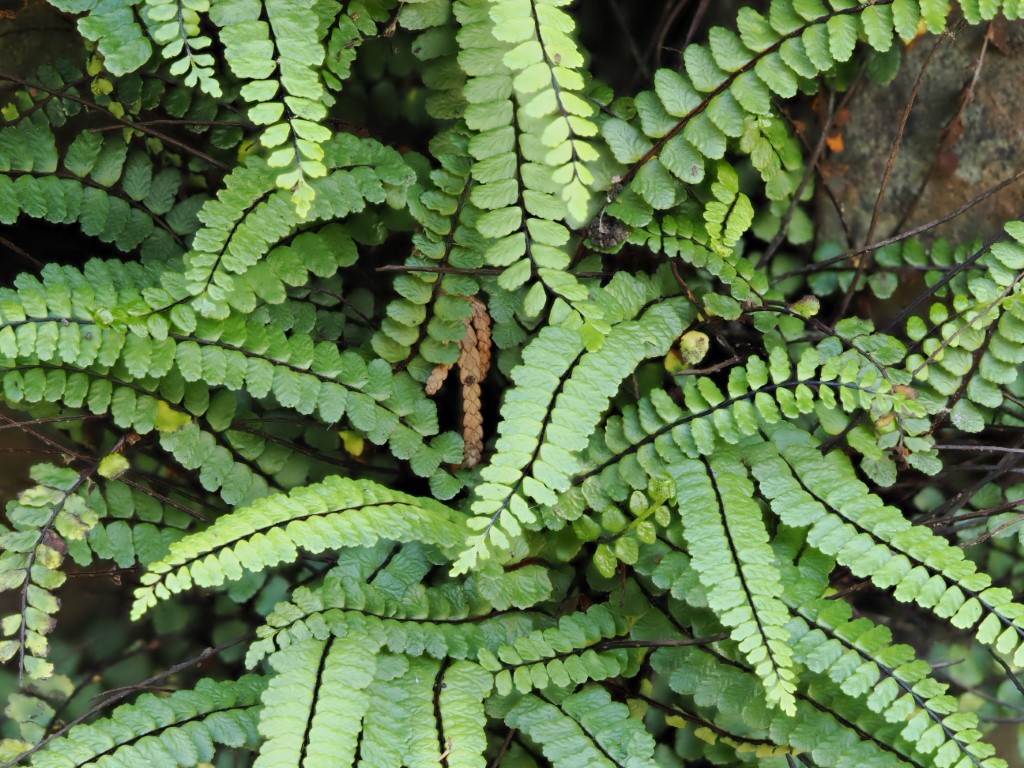
Why It Likes Walls
The affinity Maidenhair Spleenwort has for walls lies in its evolutionary adaptation to rock crevices, which man-made walls effectively replicate. Mortared or dry-stone walls provide shelter, moisture retention, and anchorage for its roots. Importantly, walls mimic natural limestone or cliff environments, with alkaline pH, shade, and minimal competition. The thin soil or mortar between stones offers just enough nutrients and stability for the plant to take hold. Because of its resilience to drought, its slow growth, and its ability to regenerate from its underground rhizome, the fern can persist for many years in these stable, if challenging, microhabitats.
Conclusion
Maidenhair Spleenwort (Asplenium trichomanes) is a small but significant component of Britain’s botanical landscape, blending naturally into both wild and built environments. The subspecies quadrivalens is particularly characteristic of the old stonework of Cumbria and other rural areas, its enduring presence adding subtle beauty and biodiversity to walls and crags alike. Though often overlooked due to its modest size, it is a fascinating species that exemplifies how wildlife can thrive in the spaces shaped by human hands.




 Andrew Chick Ecology
Leave a comment