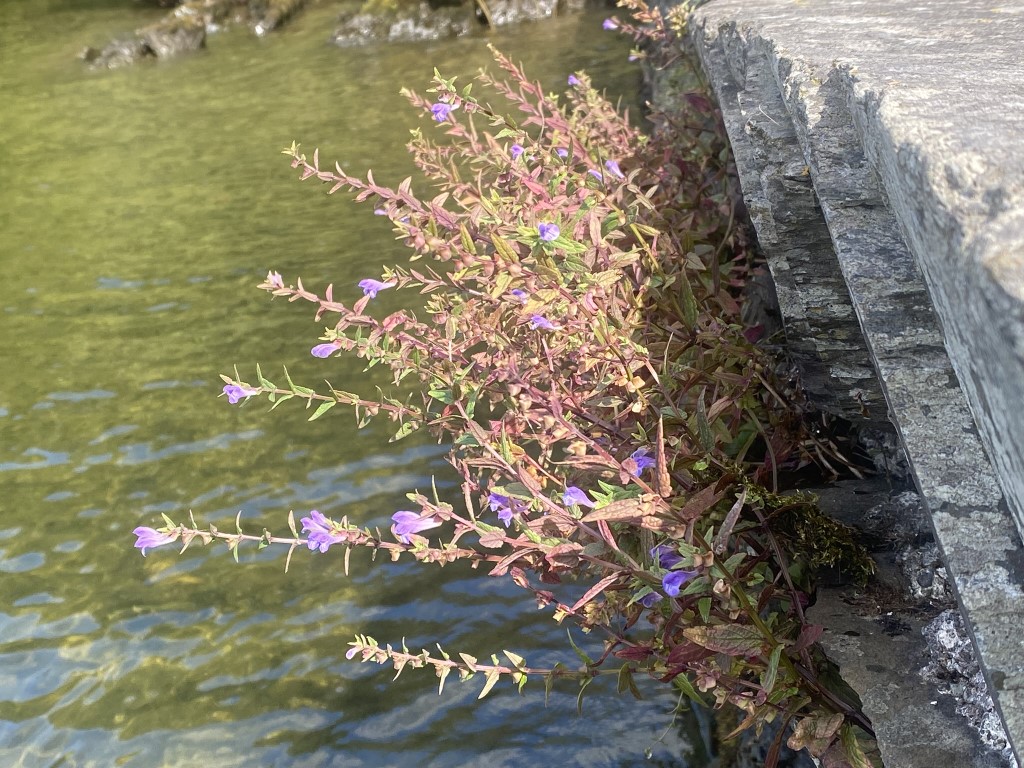
The above photograph shows Skullcap growing in a wall on the edge of Windermere Lake at Storrs Hall Hotel (c) Andrew P. Chick August 2025
Skullcap is a delicate perennial herb that thrives in a wide range of wetland habitats across the UK. It can be found along the edges of ponds, rivers and canals, in marshes, fens, fen-meadows and wet woodland, and even in dune-slacks where sandy soils remain moist. In Scotland it extends into unusual coastal niches, growing among boulder beaches washed by the sea. Though generally a lowland plant, Skullcap has been recorded at higher elevations, reaching 365 metres at High Cup Gill in Westmorland, demonstrating its ability to adapt to different conditions where damp ground is available.
In Cumbria, Skullcap shows a scattered distribution, but it is locally frequent in parts of the Lake District and in the south of the county. Much like its associate, Gypsywort (Lycopus europaeus), it is a characteristic component of tall-herb fen vegetation that develops along the margins of lakes, tarns and rivers, as well as in ungrazed marshy fields. However, a number of west coast Atlas squares lack recent records of the species, which may indicate a genuine decline in those areas rather than simply an absence of survey effort.
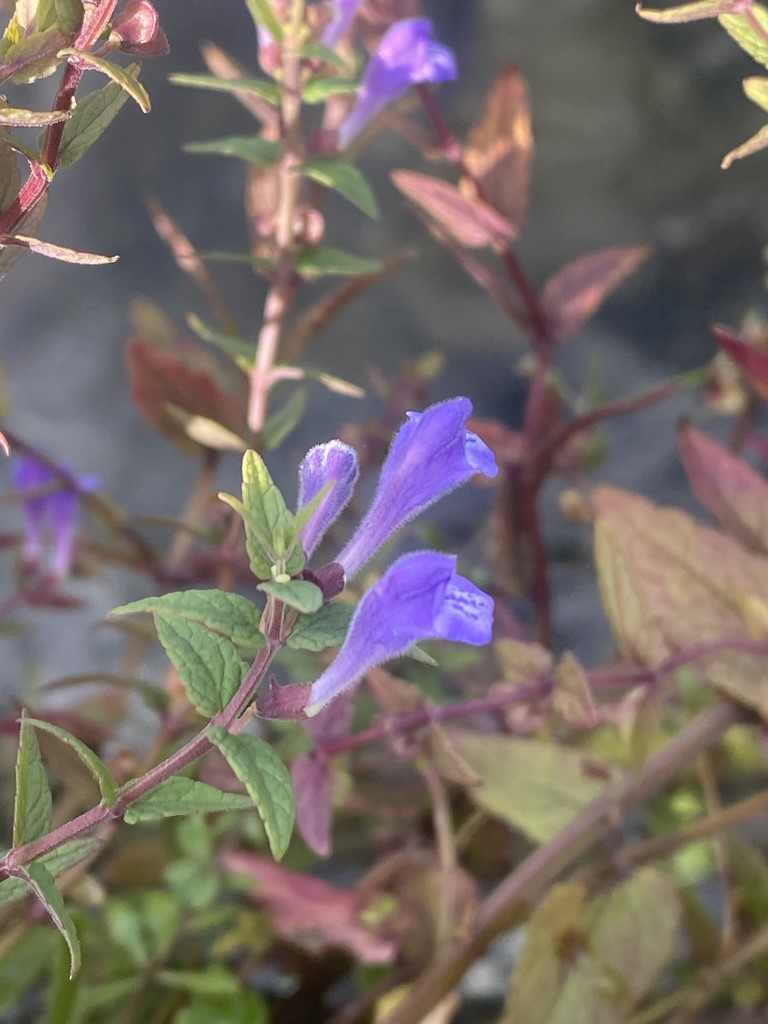
Where it persists, Skullcap is closely tied to damp soils and can most often be found on riverbanks, pond margins and canalsides. It flowers between June and September, producing small but distinctive blue blooms that are pollinated primarily by long-tongued bees. Beyond its value as a nectar source, it also has a unique ecological role, serving as the sole foodplant of the Skullcap Leaf Beetle, a striking yellow-brown beetle marked with a black head and four dark spots on its back. This intimate association highlights Skullcap’s importance within wetland ecosystems and underlines the need to monitor its populations carefully, particularly in regions where its decline may be going unnoticed.
The map below shows the distribution for May 2025.
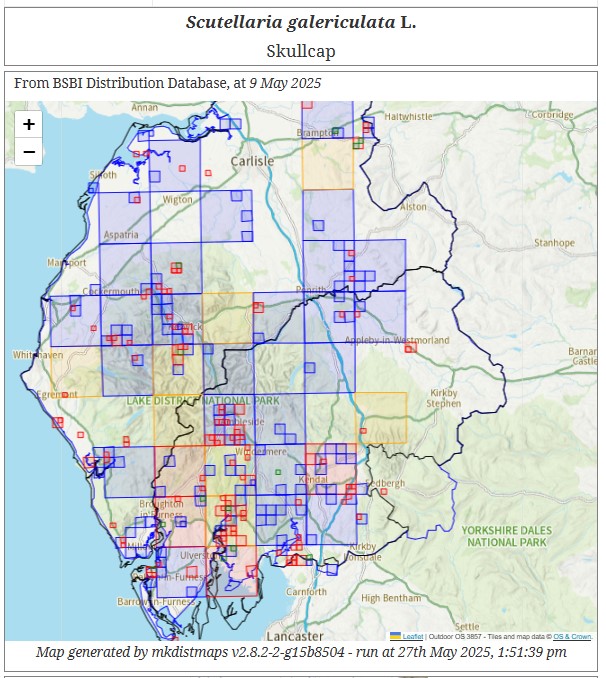
See https://www.cumbriabotany.co.uk/the-flora-of-cumbria-recording-group/flora-distribution-maps/#Scutellaria_galericulata for details of Cumbria distribution…

 Andrew Chick Ecology
Leave a comment