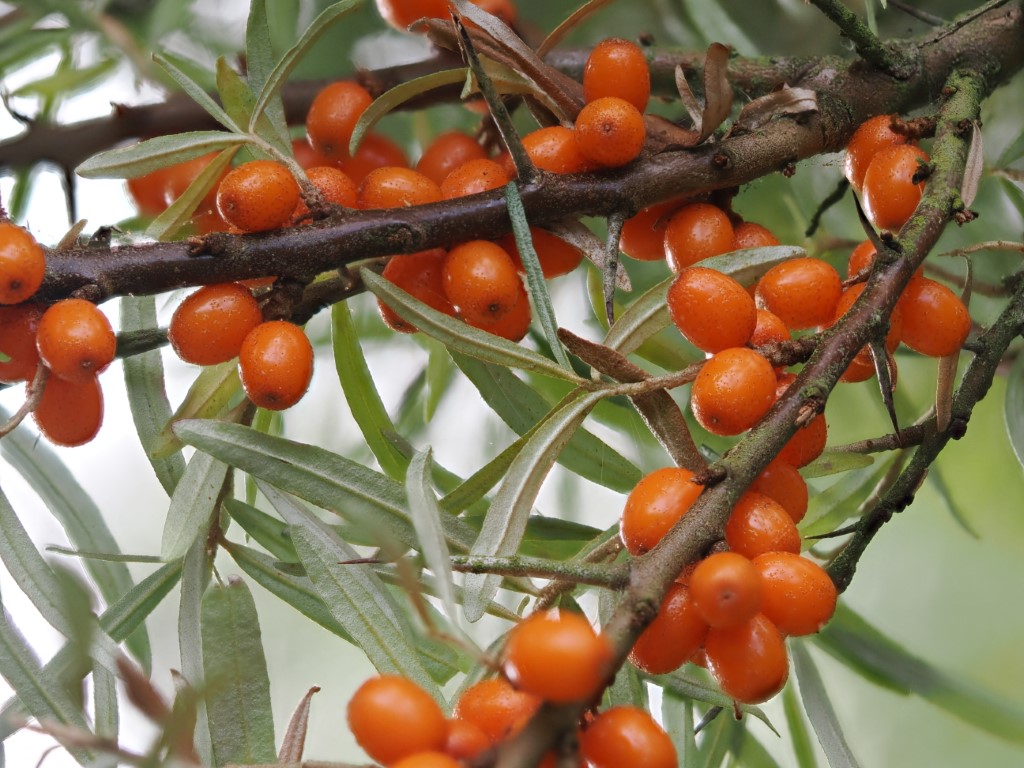
Sea buckthorn (Hippophae rhamnoides) is one of those plants that lights up the coastline in late summer and autumn, its silver-green leaves and sharp spines giving way to heavy clusters of brilliant orange berries that glow against the dunes. A plant of Europe and Asia, it has long been associated with sandy coasts and shifting shingle, its deep, binding roots holding loose soils together where little else will grow. In Britain it has found a stronghold on the east coast, especially in Norfolk and Lincolnshire, but it has also spread inland where it was planted for shelter or soil stabilisation.
Along the Cumbrian shore its presence is more scattered, though around the Ravenglass estuary it becomes a familiar feature of the dunes, the dense thickets offering shelter from the wind and salt spray. Elsewhere it occurs in small stands on sand-dunes, by seawalls, or even on patches of waste ground. These populations are not truly wild: they have sprung from earlier plantings or from seeds dropped by birds, which feast on the berries and carry them far.
Despite its thorny, often impenetrable growth, sea buckthorn is a generous plant. Its berries, unusually rich in vitamin C and oils, provide a lifeline for thrushes and other fruit-eating birds as they move down the coast in autumn, while its dense cover makes a safe refuge for migrating flocks. Walk through a dune system where the shrub has taken hold and it is easy to understand both its value and its threat: a giver of food and shelter, but also a plant that, if left unchecked, can smother the open sands and crowd out the rarer, more delicate flowers of the dunes.

 Andrew Chick Ecology
Leave a comment