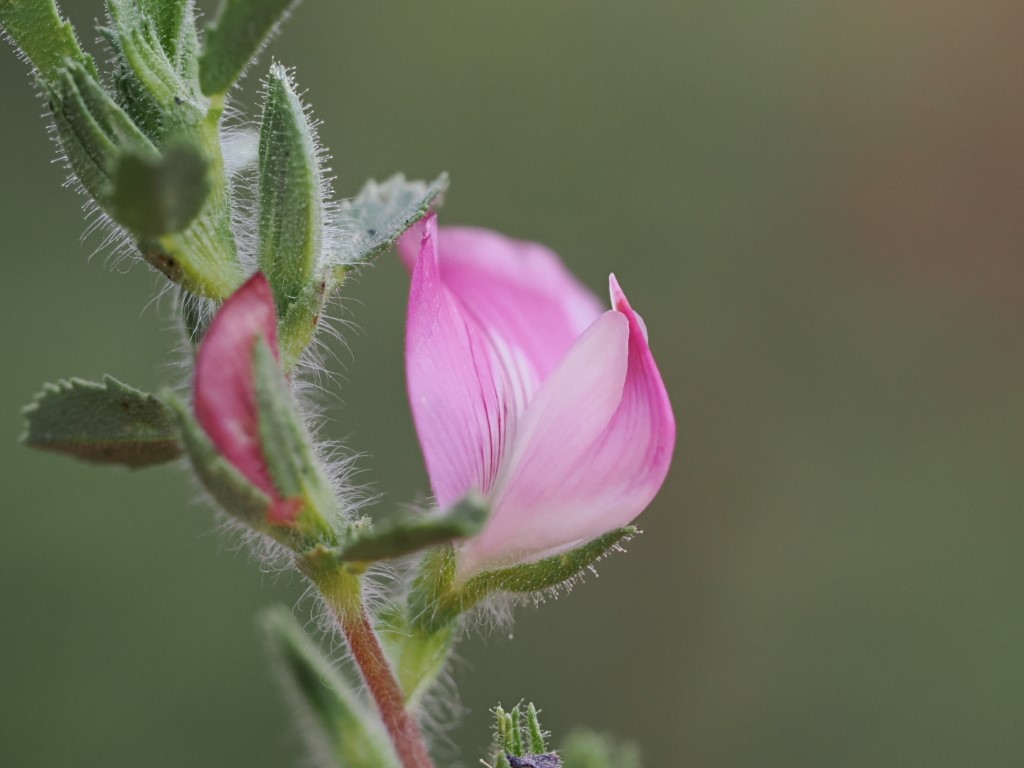
Common Restharrow is a familiar wildflower of summer, found in dry, open places where it thrives in sandy or stony soils. Its cheerful pink flowers and sprawling, often spiny stems make it one of the more distinctive members of the pea family (Fabaceae).
Identification
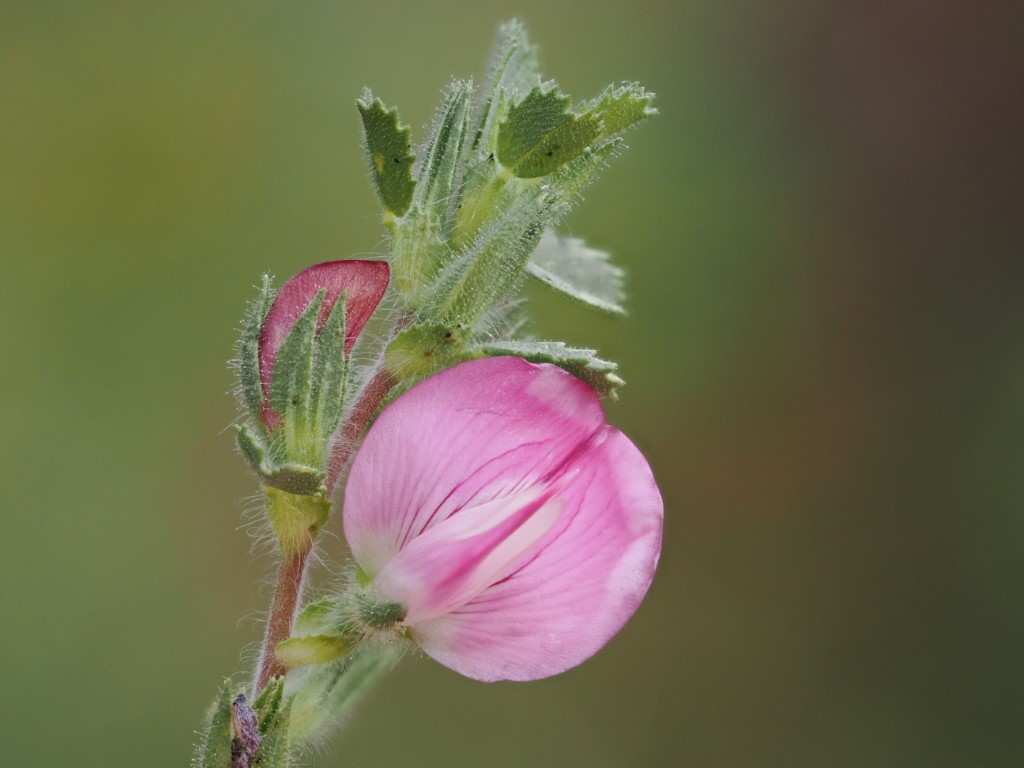
This low, spreading perennial is easily recognised by its wiry, often tough stems that creep across the ground or form loose mats. It bears small, trifoliate leaves that are slightly hairy, with toothed margins. The flowers, appearing from June to September, are striking pea-flowers of a vivid pink, sometimes with a purple tinge, and are carried singly or in small clusters. When in full bloom, especially in large numbers, Common Restharrow can create dazzling patches of colour. Its common name comes from its tough, fibrous stems which were once notorious for clogging or “arresting” the progress of farmers’ harrows as they tilled the soil.
Distribution in the UK
Widespread throughout much of Britain and Ireland, Common Restharrow is most abundant on light, base-rich soils where competition from taller plants is reduced. It is especially associated with coastal habitats, road verges, dry grasslands, and banks of rivers or fields. In some inland areas it is less common, but along the coasts it is often frequent and locally abundant, forming important elements of dune and grassland communities.
Folklore and Uses
The name Restharrow reflects the plant’s agricultural nuisance in former times, its stubborn roots being almost impossible to remove from arable land. In traditional herbal medicine, it was valued as a diuretic and was used in remedies for kidney and bladder complaints. Restharrow tea was sometimes taken to ease urinary troubles, while the roots were thought to have cleansing properties. Folklore also associated the plant with protection against misfortune, and its hardiness gave it a symbolic link with resilience and stubbornness.
In Cumbria
In Cumbria, Common Restharrow shows a distinctive distribution. It is fairly common along the entire coastline, where it is especially abundant on the dunes and dune-slacks, creating carpets of pink during its flowering season. Inland, it occurs frequently in the Eden Valley, where the lighter, base-rich soils provide suitable conditions. Elsewhere in the county it is rather uncommon, being largely absent from the uplands and heavy soils of the central Lake District. Its most striking displays are undoubtedly along the coast, where it contributes to the richness and beauty of dune flora in midsummer.
Common Restharrow may once have been a pest to the plough, but today it is celebrated as a beautiful component of dry grasslands, dunes, and sandy soils. Its bright flowers not only provide a splash of colour but also attract a range of pollinators, making it an important species for both biodiversity and cultural history.


 Andrew Chick Ecology
Leave a comment