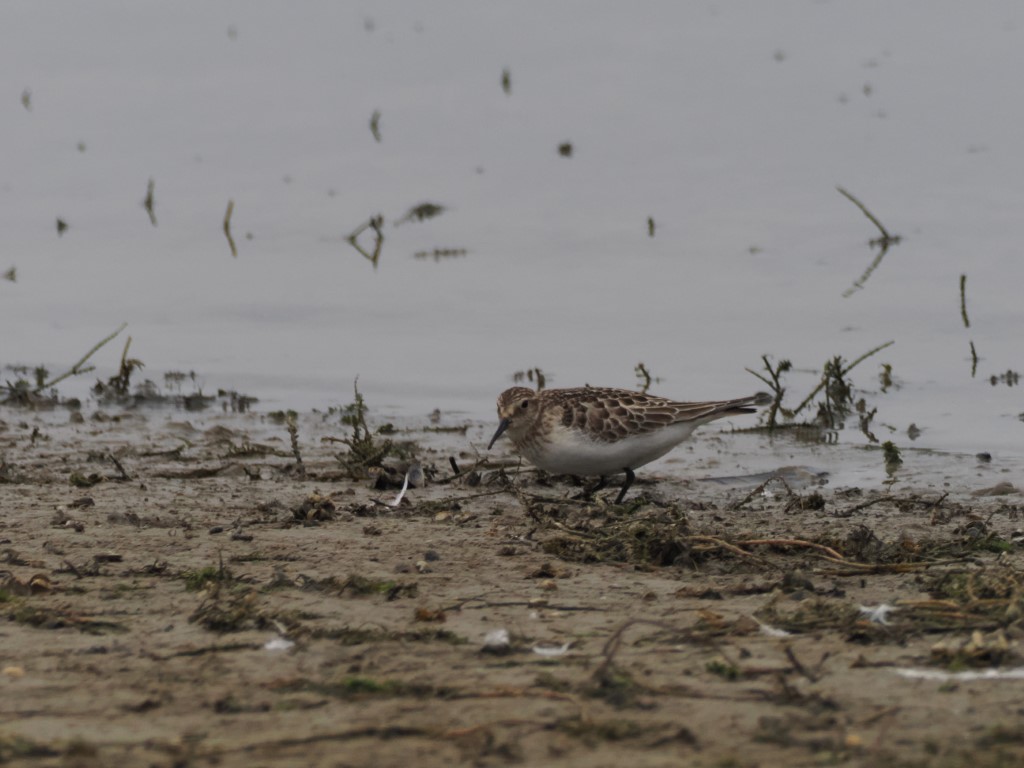
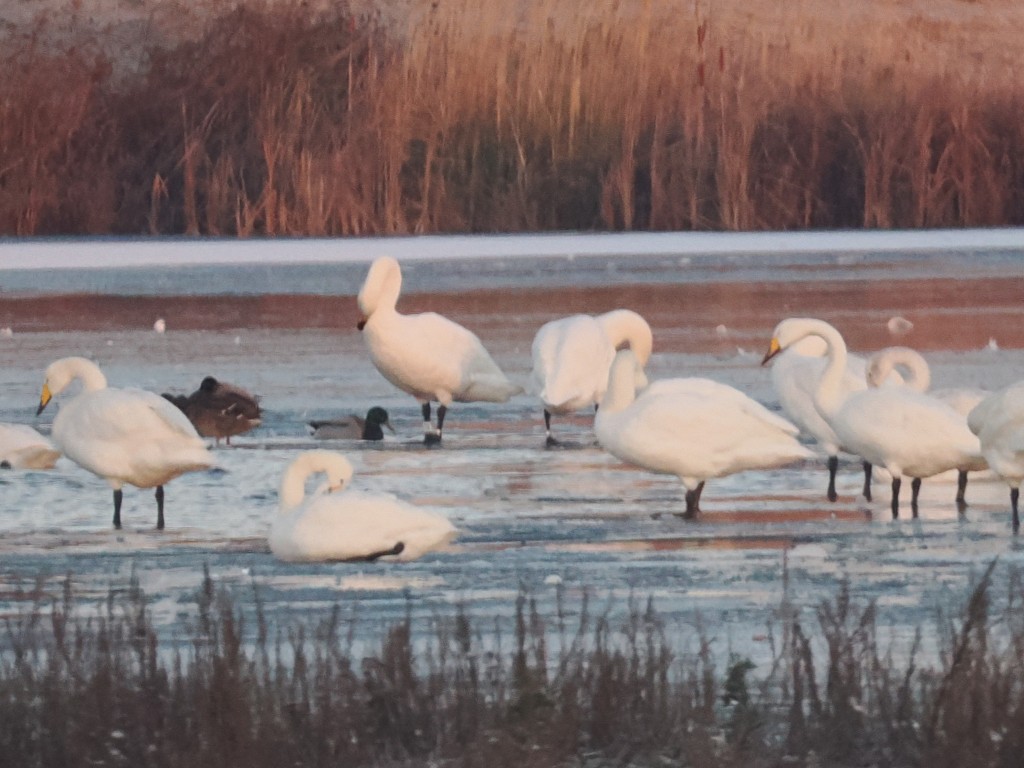
Photo: Baird’s Sandpiper at Rutland Water 14/10/25 (c) Andrew Chick
Every autumn, British birders scan the flocks of Dunlin and Ringed Plover on our estuaries and headlands, hoping for something a little different, a subtle wader with sandy-brown upperparts, long wings, and a neat, delicate bill. When one appears, the news spreads fast: a Baird’s Sandpiper has dropped in. For many, it’s a thrilling encounter, not just because of the bird’s understated beauty, but because it represents one of the most remarkable journeys in the bird world. This tiny sandpiper, weighing barely 40 grams, has crossed an ocean.
Baird’s Sandpiper Calidris bairdii breeds in the high Arctic of North America, from Alaska across northern Canada to Greenland. Once the brief Arctic summer ends, it undertakes a migration of extraordinary scale, travelling thousands of miles south to spend the northern winter on the vast grasslands and wetlands of southern South America, as far as Tierra del Fuego and Patagonia. It is a bird built for distance, sleek and long-winged, capable of sustained flight over enormous expanses of ocean and land. The vast majority of the population follows a route through the central Americas, but every year, a small number stray eastwards across the Atlantic.
When one of these birds appears on British shores, it has taken a route that nature never intended, a genuine vagrant, blown or drifted off course by weather systems during migration. Most Baird’s Sandpipers that reach Europe do so in late August and September, coinciding with the peak of transatlantic storms that sweep across from North America. Some birds are likely carried eastward by strong westerly winds associated with tropical storms or low-pressure systems that spin out from the remnants of Atlantic hurricanes. After a journey of perhaps 3,000 miles, these small travellers arrive on our side of the ocean, often exhausted but still capable of finding suitable feeding grounds among Britain’s coastal wetlands and beaches.
In the UK, the Baird’s Sandpiper remains a rare but regular autumn visitor, with typically fewer than ten individuals recorded each year. Some years see small influxes, while others pass without a single confirmed sighting. Most records come from western coasts, particularly the Isles of Scilly, Cornwall, Ireland, and western Scotland — where transatlantic drift migrants first make landfall. However, the species has been recorded inland as well, often turning up at reservoirs or flooded gravel pits, where it can linger for days feeding quietly among Dunlin and Little Stints as happened at Rutland Water in October 2025 with one spending time at Whitwell Creek.
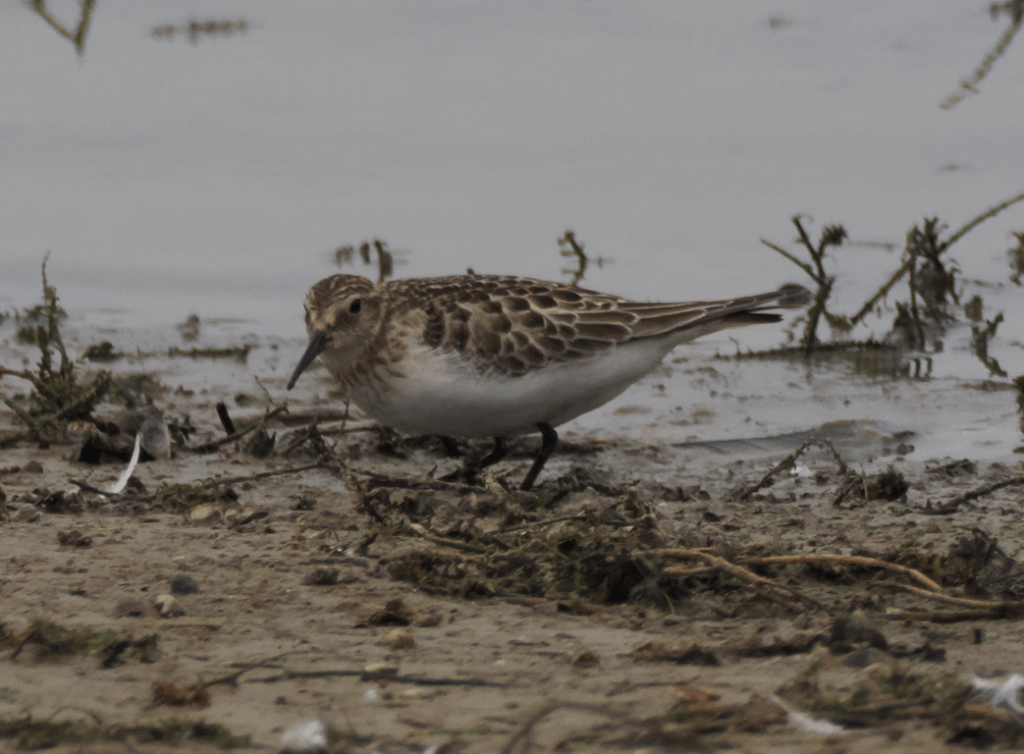
Part of what makes the Baird’s Sandpiper so fascinating is that it is easy to overlook. It lacks the striking rufous tones of a Curlew Sandpiper or the sharp contrast of a Little Stint. Instead, its beauty lies in its subtlety — soft grey-brown plumage finely scalloped with darker markings, a neat, square-ended body, and a long-winged silhouette that gives it a distinctive, almost attenuated look when at rest. Its identification requires care and experience, as several small sandpipers share similar features. The combination of pale, unmarked underparts, a scaly brown upper surface, and those long primary tips extending beyond the tail is the key. For many birders, successfully picking out a Baird’s among a restless flock of waders is a genuine badge of skill and patience.
The rarity of Baird’s Sandpiper in Britain stems not from small population size, but from geography. It breeds entirely within the Nearctic — the New World — and has no natural migration route toward Europe. Only the occasional combination of strong winds, weather patterns, and navigational drift brings individuals this far east. Once here, many of these birds continue moving southwards along the Atlantic coasts of Europe and North Africa, occasionally reaching as far as Spain or the Canary Islands. Most, however, never make the return crossing. For a bird adapted to a transcontinental flight from the Arctic to the pampas, the accidental detour across an ocean is an evolutionary dead-end — though one that provides European birders with a rare treat.
Sightings in the UK have become slightly more frequent over the past few decades, partly thanks to increased observer coverage, digital reporting, and a better understanding of wader identification. Improved wetland management and the creation of new habitat have also helped, providing safe resting sites where long-distance wanderers can pause to feed. Even so, every Baird’s Sandpiper remains an event. It is a species that connects two continents, a living reminder of the vast and unpredictable reach of bird migration.
There’s something quietly humbling about watching one probe the mudflats of a Cornish estuary or pick delicately among pebbles on a Scottish beach. This bird should be feeding thousands of miles away on the other side of the world, yet here it is, driven by instinct, wind, and chance. The sight of a Baird’s Sandpiper in Britain is a small miracle of misdirection — a traveller out of place but perfectly at home among our autumn waders. Its presence tells a story not just of rarity, but of endurance and the astonishing power of migration, reminding us that even the smallest wings can cross oceans.





 Andrew Chick Ecology
Leave a comment