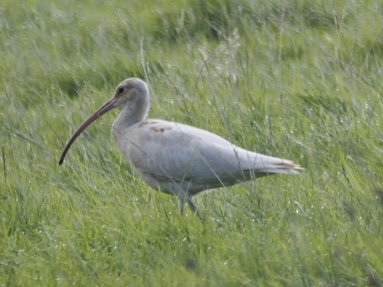
Photo: Crazy leucistic Curlew at Barrow-in-Furness Sept 2025
Every so often, a familiar bird turns up looking strangely unfamiliar — a Blackbird that’s ghostly white, a Starling with snow-white patches, or a Chaffinch wearing a frosty wash across its wings. These pale-plumaged individuals often draw attention, and they’re sometimes described (incorrectly) as “albino.” In most cases, though, they are leucistic.
What Is Leucism?
Leucism is a partial loss of pigmentation caused by a genetic condition that prevents melanin from being deposited in feathers, skin, or scales. Unlike albinism — which results from a total lack of melanin production and gives birds pink eyes and bare skin — leucism doesn’t affect the eyes or soft parts. A leucistic bird usually retains its normal eye colour, legs and bill tones, while its feathers may appear pale, patchy, or completely white.
The pattern can vary:
- Partial leucism: irregular white or pale patches (commonest form).
- Full leucism: all feathers lack pigment, giving a ghostly white appearance.
How Common Is It?
Leucism is uncommon but not rare. Most experts estimate that fewer than one in several thousand birds show visible leucistic traits in the wild. However, because common species (such as Blackbirds, House Sparrows, and Chaffinches) exist in vast numbers, occasional leucistic individuals are regularly seen. In small or declining populations, though, such birds can be genuinely noteworthy.
Why Does It Happen?
Leucism occurs when pigment-producing cells (melanocytes) fail to migrate or function correctly during feather growth. The condition is genetic, though it can also be influenced by injury or nutritional stress during feather formation. It doesn’t always affect the same feathers from year to year — some birds appear “normal” after a moult, while others retain their pale patches for life.
Survival and Disadvantages
A leucistic bird often stands out, which can make it more visible to predators and less effective at camouflage. Nevertheless, many survive perfectly well, especially in urban or garden settings where predation pressure is lower. Their condition doesn’t normally affect behaviour, song, or breeding.
Why It Captures Attention
Birders and photographers are naturally drawn to anything out of the ordinary, and leucistic individuals offer that element of surprise — a splash of rarity in the everyday. They remind us that even the most familiar species can throw up a striking variation that challenges our first impressions and brightens a day in the field.

 Andrew Chick Ecology
Leave a comment