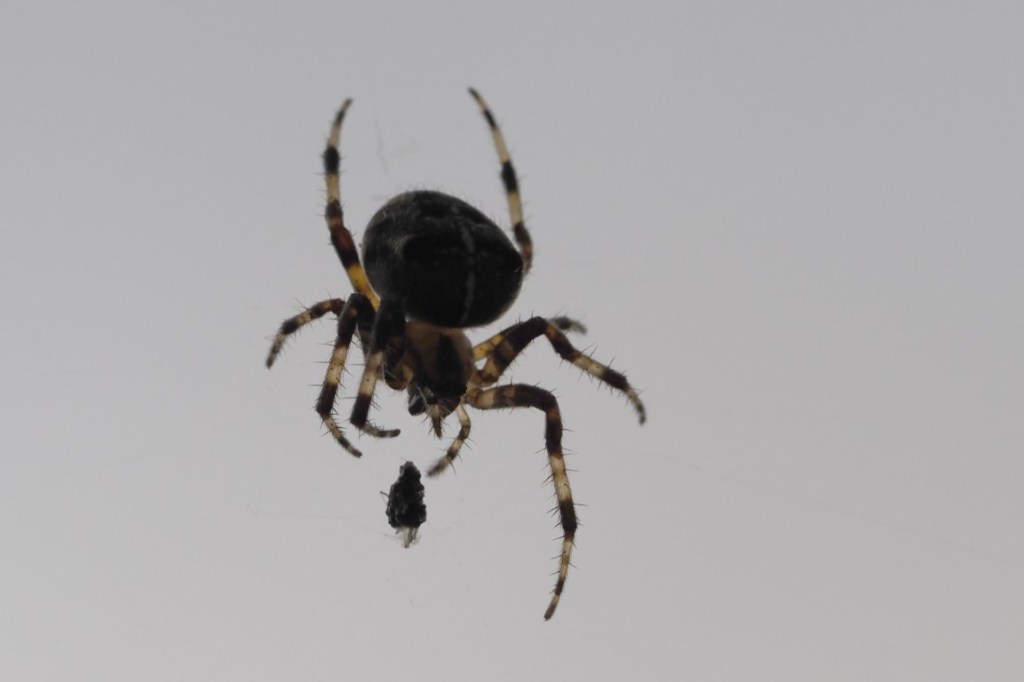
Photo of a Garden Cross Spider, Araneus diadematus in my Troutbeck garden – Andrew Chick October 2025
As the days shorten and the air begins to cool, it becomes impossible not to notice the sudden abundance of large, orb-shaped webs glistening in the morning dew. Hanging between hedges, stretched across garden paths, or suspended in the corners of windows, each web holds its architect — the Garden Cross Spider, Araneus diadematus. For many people, this spider is as much a part of autumn as falling leaves and misty mornings. Their apparent explosion in numbers at this time of year, however, is not the result of a population boom but rather the final act in a drama that has been unfolding quietly all summer.
The Garden Cross Spider is one of Britain’s most familiar arachnids, instantly recognisable by the pale cross-shaped markings on its back. Although they seem to appear suddenly in September and October, these spiders have been present since spring. Their life cycle begins the previous autumn, when the females lay hundreds of tiny eggs encased in silk cocoons hidden among leaves or under window ledges. These eggs overwinter safely through the cold months and hatch the following spring. The spiderlings disperse by a behaviour known as “ballooning,” releasing silk threads that catch the breeze and carry them to new locations, sometimes miles away. Through the summer, they feed on small insects and gradually grow, moulting several times as they develop.
By late summer, the surviving spiders have reached adulthood, and it is then that they become most visible. The females, which are larger and more sedentary, begin constructing the large, symmetrical webs that are the hallmark of the species. Each web is an engineering marvel, built anew every night and positioned to intercept flying insects. Morning dew or low sunlight reveals them in their full complexity, and it is at this point that people begin to notice the sheer number of webs around gardens, hedgerows, and walls. The truth is that the spiders have been there all along — it’s just that they are now fully grown, active, and far more conspicuous.
Autumn also marks the breeding season. Males, smaller and less robust than females, abandon their webs and begin wandering in search of mates. It is often during these weeks that people find spiders indoors, not because they are seeking warmth, but because a wandering male has accidentally entered a house while searching for a partner. After mating, the female produces her egg sacs, attaching them to sheltered spots where they will survive the winter. Soon after, both males and females die as the weather turns colder, leaving the next generation to repeat the cycle.
The impression of an autumn “invasion” is therefore a combination of biology and visibility. The spiders are at their largest, their webs most conspicuous, and insect prey abundant, all of which draw attention to them. Warm, settled weather can prolong their activity well into November, while damp or stormy conditions quickly destroy their webs and reduce sightings. Each individual is living its final weeks, focused entirely on reproduction and feeding before the first frosts arrive.
The Garden Cross Spider plays an important ecological role, consuming vast numbers of flies, mosquitoes, and small insects. Despite their size and sometimes intimidating appearance, they are harmless to humans, and their presence is a sign of a healthy garden ecosystem. Watching one patiently rebuild its web at dusk or wrap a captured insect in silk is a fascinating reminder of the intricacy of nature on even the smallest scale.
By winter, the adults will have disappeared, their webs reduced to tattered threads caught in dead vegetation. But the next generation already waits in tiny egg sacs, ready to hatch when spring warmth returns. The autumn abundance of Garden Cross Spiders is therefore not an invasion but a finale — a brief, visible climax to a life spent in quiet service to the balance of the natural world. Each silken web shining in the morning dew tells the same story: that even in decline, nature finds beauty in the cycle of renewal.


 Andrew Chick Ecology
Leave a comment