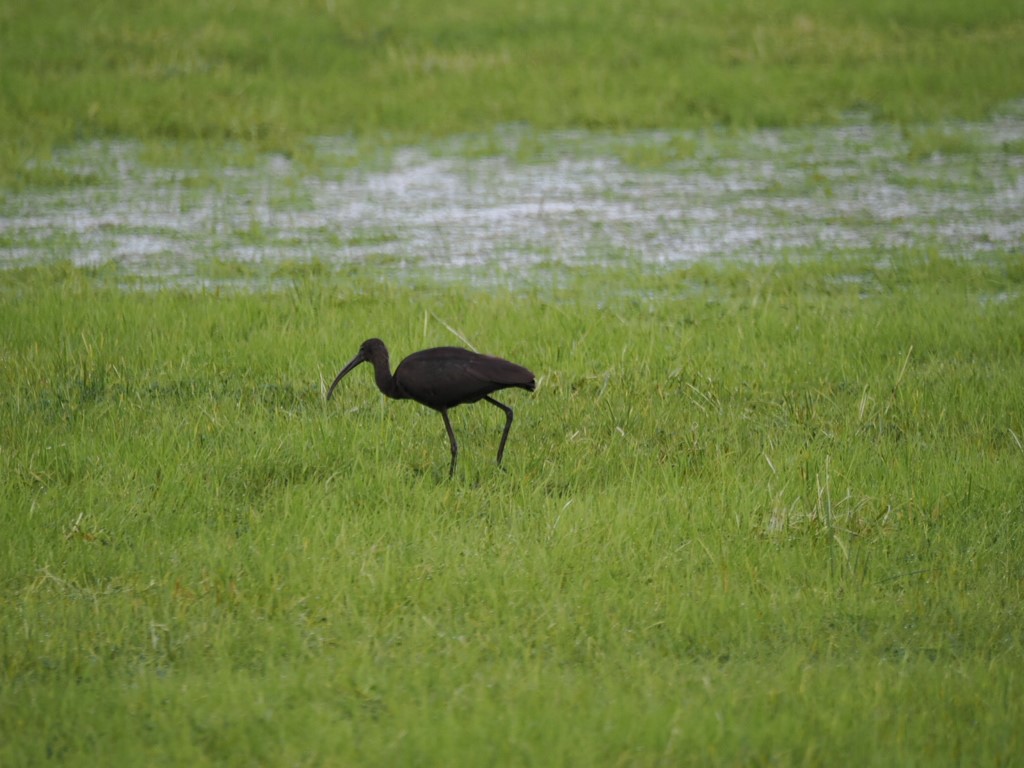
Photo: Glossy Ibis in southern Cumbria Sept 2025 (c) Andrew Chick
In recent years, birdwatchers across Britain have noticed an unmistakable trend, the Glossy Ibis, once a genuine rarity, is appearing with increasing regularity in wetlands and coastal marshes throughout the country. Once the preserve of excited “rare bird alerts,” the species is now turning up so often that sightings barely raise an eyebrow among local birders. What was once a bird of far-off lagoons and southern wetlands has quietly become an increasingly familiar feature of the British landscape. But what lies behind this shift, and why is the Glossy Ibis expanding its range so noticeably into the UK?
The Glossy Ibis, Plegadis falcinellus, is a striking wader. In good light, its plumage reveals deep bronze, copper, and emerald tones that give the bird its name. Native to warmer parts of southern Europe, Africa, Asia, and the Americas, the species has always had a wide distribution but was historically scarce in northern Europe. In Britain, it was once classed as a vagrant, recorded only during occasional influxes. Over the past two decades, however, records have increased dramatically. Flocks that once numbered two or three individuals can now reach dozens, and the species is seen in every season, from autumn passage to midwinter.
The reasons for this expansion are complex but interconnected, reflecting broader environmental and climatic changes across Europe. One of the main drivers is climate change. As temperatures have warmed and winters have become milder, the northern edge of the Glossy Ibis’s range has shifted accordingly. Wetlands in France, Spain, and Portugal — long-time breeding strongholds — now experience hotter, drier summers that can reduce the availability of shallow feeding areas. At the same time, wetlands in north-west Europe have become increasingly suitable, providing mild conditions and abundant feeding opportunities throughout much of the year. The UK’s extensive network of managed reserves, coastal lagoons, and restored floodplains now offers ideal habitat for this adaptable wader.
The Glossy Ibis is also an inherently mobile species. It breeds colonially, often in large mixed heronries, and post-breeding dispersal can involve thousands of birds moving north and west in search of food and new territory. Improved wetland protection and the success of conservation initiatives in southern Europe — particularly in the Guadalquivir Marshes in Spain and the Camargue in France, have led to population booms. As these colonies have grown, surplus birds, especially juveniles, have begun to wander further afield. Many of these individuals have found their way to Britain and Ireland, where they increasingly linger for long periods rather than continuing south.
Another factor aiding this colonisation is the growth of suitable habitat in the UK itself. Over the last few decades, the creation of new wetlands, through managed realignment and nature reserve projects, has transformed parts of the lowland landscape. Areas such as the Somerset Levels, the Ouse Washes, and the Humber Estuary have become rich feeding grounds for waterbirds. Glossy Ibises favour shallow wetlands where they probe the mud for invertebrates, frogs, and small fish, precisely the habitats that have expanded as floodplain restoration has become a conservation priority. Even temporary flooded fields, reservoirs, and sewage lagoons now provide suitable stopover sites.
The species’ increasing familiarity has also been aided by its resilience and adaptability. Glossy Ibises are social, opportunistic feeders, and can coexist with herons, egrets, and other wading birds without direct competition. They readily exploit artificial wetlands and agricultural areas, and appear untroubled by moderate human presence. Birds have been observed feeding alongside Little Egrets in ditches, probing flooded meadows, and roosting in reedbeds. Their growing confidence and tolerance make them more likely to remain visible and accessible to observers.
In recent winters, small groups have persisted at several British sites, with the Somerset Levels and Poole Harbour among the most reliable. In 2020, multiple birds remained through the winter in East Anglia, and in subsequent years, reports have come from as far north as Scotland. Some evidence now suggests that a few individuals may have attempted to breed within the UK, though confirmed nesting has yet to be proven. If trends continue, it seems only a matter of time before the first successful British breeding record is established.
While the increasing number of Glossy Ibis sightings adds a touch of the exotic to British birding, their presence also tells a larger story about changing ecosystems. Climate shifts are redistributing bird populations across Europe, with many southern species extending their range northwards as conditions become suitable. The Little Egret, once a rarity itself, now breeds commonly in Britain, and the Great White Egret and Spoonbill are following the same trajectory. The Glossy Ibis appears to be the next in line, a natural coloniser making the most of new opportunities.
The bird’s expanding presence is, therefore, both a symbol of success and a warning. It highlights the benefits of wetland conservation, showing how restored habitats can attract diverse wildlife, but it also underlines the rapid pace of environmental change that is reshaping the continent’s birdlife. For many, spotting a Glossy Ibis feeding among the reeds or sweeping its curved bill through shallow water remains a special moment, a reminder that migration and adaptation are ongoing, and that even in a well-watched country like Britain, the avian story is still evolving.
So next time you catch sight of that bronze shimmer over a wetland, take a moment to appreciate what it represents. The Glossy Ibis is no longer a rare visitor; it is a symbol of the living, shifting nature of our landscapes, a southern bird rewriting the boundaries of what it means to be at home in Britain.



 Andrew Chick Ecology
Leave a comment