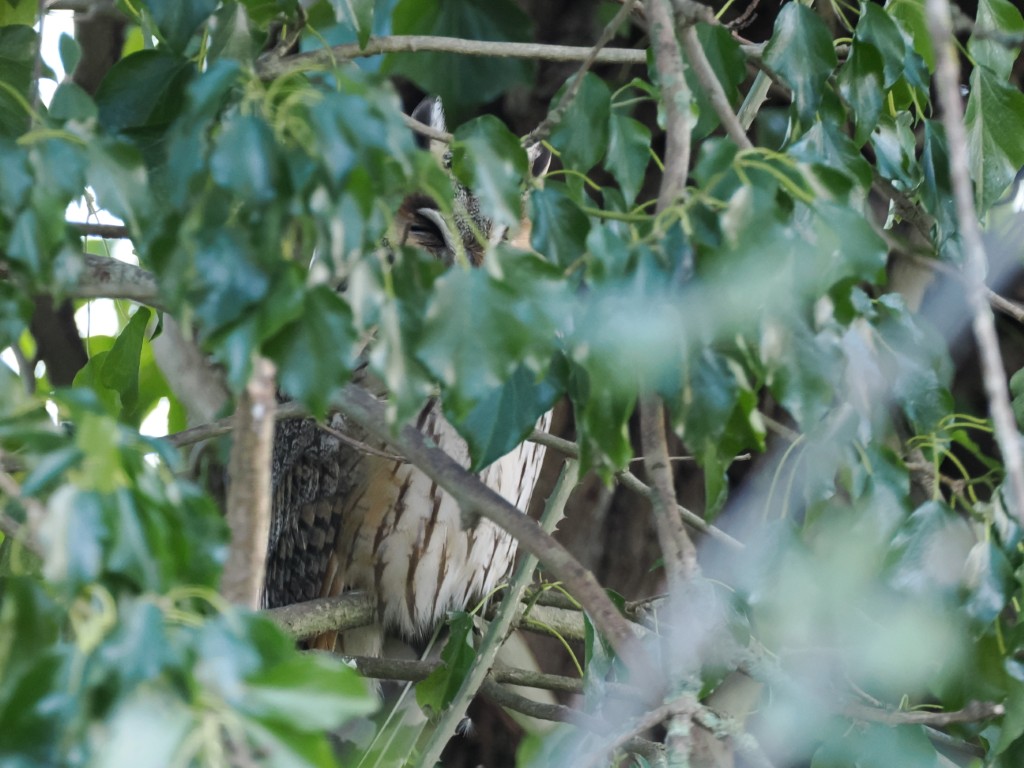
Despite how prominent they look, an owl’s ear tufts have nothing to do with hearing. Their primary role is visual: when an owl is perched, raised ear tufts help break up its outline and can resemble twigs or broken branches, improving camouflage and reducing the chance of being detected by predators or mobbing birds. Ear tufts are also an important part of an owl’s body language, with birds raising, lowering or flattening them to signal alertness, aggression, curiosity or an attempt to remain inconspicuous. In addition, they aid species recognition, allowing owls to identify members of their own species by silhouette, particularly in low light. Many owls, such as Barn Owl and Tawny Owl, lack ear tufts altogether, while others including Long-eared, Short-eared and Eagle Owls have very prominent ones, and in all species the actual ears are hidden beneath the facial feathers, often asymmetrically placed to allow precise sound localisation.
Photograph of one of the Deeping Lake LWT Long-eared Owls January 2026





 Andrew Chick Ecology
Leave a comment