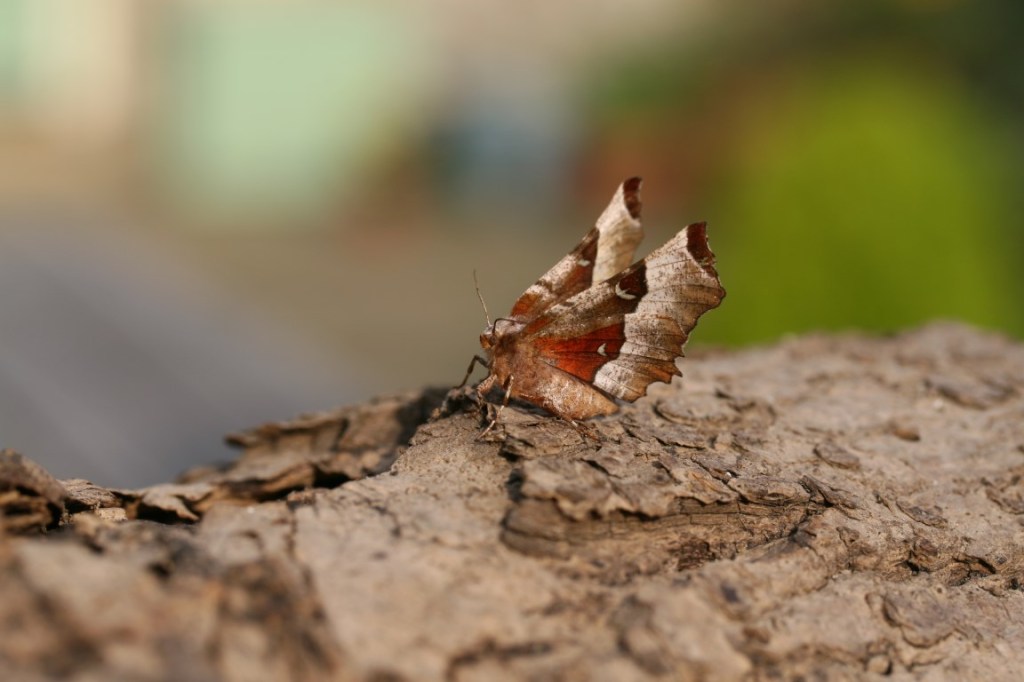
The Purple Thorn (Selenia tetralunaria) is one of Britain’s more distinctive geometrid moths. With its beautifully scalloped wings, rich purplish-brown colouring and characteristic resting posture, it is an attractive species that can sometimes be found around woodland, hedgerows and gardens.
Despite its name, the Purple Thorn is not usually an obvious bright purple. The wings are generally a mixture of reddish-brown, purplish-brown and grey, crossed by darker lines and marked with a small pale crescent or moon-shaped spot. The strongly scalloped edges of the wings add to its distinctive appearance.
Perhaps the most characteristic feature of the Purple Thorn is the way it rests with its wings held partly raised and angled above the body, rather than lying flat like many other moths. This unusual posture, combined with the irregular wing edges, helps break up its outline and provides excellent camouflage amongst dead leaves and vegetation.
Purple Thorns occur in a range of wooded habitats, including deciduous woodland, woodland edges, hedgerows, scrub, parks and mature gardens. The caterpillars feed on a variety of trees and shrubs, including birch, oak, alder, hawthorn and blackthorn.
In much of Britain there are two generations each year. The first adults are generally on the wing during April and May, with a second generation appearing from July into August. Interestingly, the two generations can look slightly different, with the summer generation generally being smaller.
Like many nocturnal moths, Purple Thorns are attracted to light and can occasionally appear in moth traps. During the day they are much more difficult to find, their colouring and angular shape allowing them to blend remarkably well into their surroundings.
There are several other British “thorn” moths, including the Early Thorn, August Thorn, September Thorn and Lunar Thorn, and separating them can sometimes require a careful look at wing shape and markings. The Purple Thorn, however, is particularly attractive, and its combination of scalloped wings, subtle purple-brown tones and unusual resting posture makes it one of the more memorable moths of our woodlands and gardens.




Leave a Reply