
The Northern White-faced Owl (Ptilopsis leucotis) is a distinctive small owl of Africa’s dry savannas and open woodlands. Although relatively small compared with many other owls, it is larger and more robust than most scops-owls and is immediately recognisable when seen well.
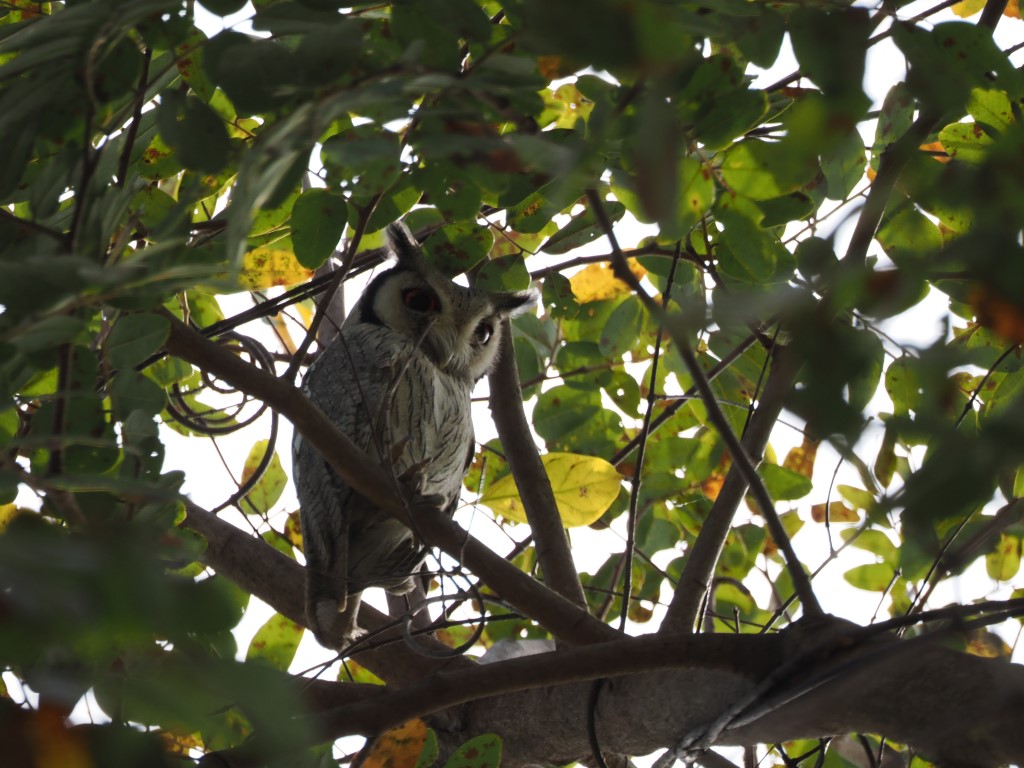
Its plumage is predominantly pale grey, intricately patterned with darker markings that provide excellent camouflage against tree bark. The most striking feature is the large white facial disc, strongly outlined in black and surrounding a pair of vivid yellow-orange eyes. Prominent ear tufts add to its characteristic appearance and can be raised or flattened depending on the bird’s behaviour.
The Northern White-faced Owl occurs across a broad belt of sub-Saharan Africa, principally north of the Equator. It favours dry savanna, thorn scrub and open woodland, particularly landscapes containing scattered mature trees suitable for roosting and nesting.
During the day it usually remains inactive, roosting in trees before emerging around dusk to hunt. Surprisingly, individuals sometimes choose relatively open and conspicuous daytime perches, although their cryptic grey plumage can still make them remarkably difficult to spot. At night they hunt a variety of small prey, including insects and other invertebrates as well as small mammals, birds and reptiles.
The species is perhaps particularly well known for its unusual defensive behaviour. When threatened, a Northern White-faced Owl can dramatically alter its appearance by erecting its feathers and spreading its wings to appear much larger. In other circumstances it may adopt the opposite strategy, compressing its plumage, narrowing its eyes and elongating its body to become surprisingly thin and inconspicuous.
The typical call is a quiet, two-parted “huu-hoooo”, often delivered repeatedly during the night. Vocalisations are particularly useful for identification because the species is extremely similar in appearance to the Southern White-faced Owl (Ptilopsis granti). The two are best separated by their calls, although identification is simplified by the fact that there is little or no overlap between their normal geographical ranges.
With its striking white face, bright eyes and prominent ear tufts, the Northern White-faced Owl is one of the most distinctive nocturnal birds of the African savanna.
All photos taken in Gambia (c) Andrew P. Chick 2026



Leave a comment