
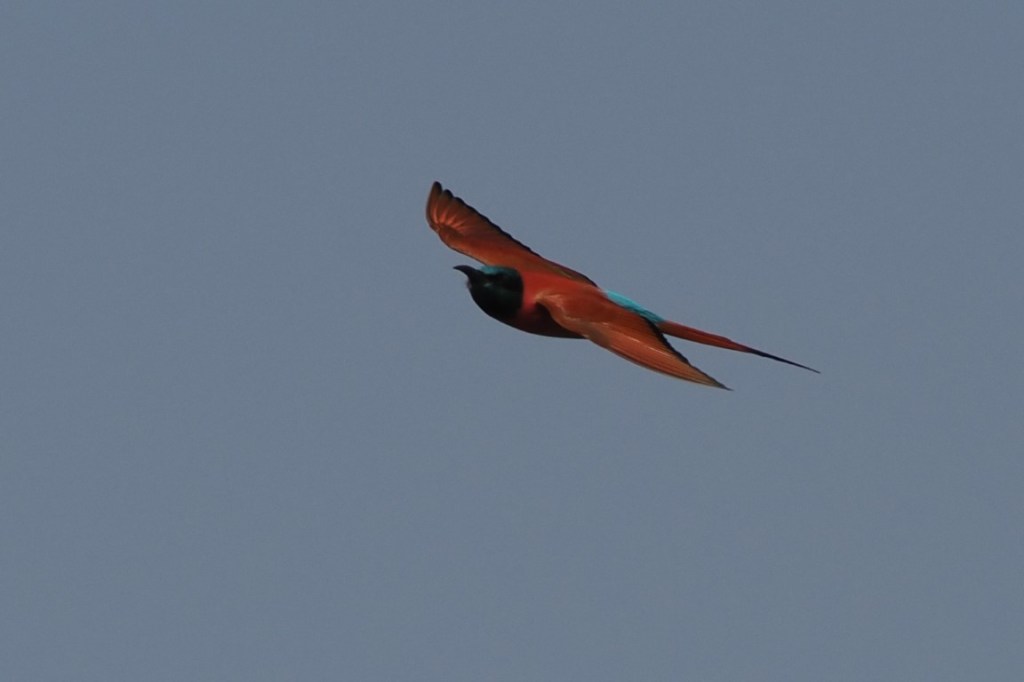
The Northern Carmine Bee-eater (Merops nubicus) is one of Africa’s most spectacular bee-eaters. A large and unmistakably colourful species, it has a predominantly rich carmine-red body contrasting strongly with a blue-green head, throat and belly. The central tail feathers are elongated into slender streamers, adding to its elegant appearance. In flight, the blue-green rump becomes conspicuous, while the rosy underwings have a contrasting dark trailing edge.
Northern Carmine Bee-eaters occur across sub-Saharan Africa, particularly in the more open regions of West, Central and East Africa. They inhabit a variety of savanna and open-country habitats, often associated with rivers and wetlands. The species is highly sociable and is usually encountered in flocks, sometimes numbering hundreds or even thousands of birds.
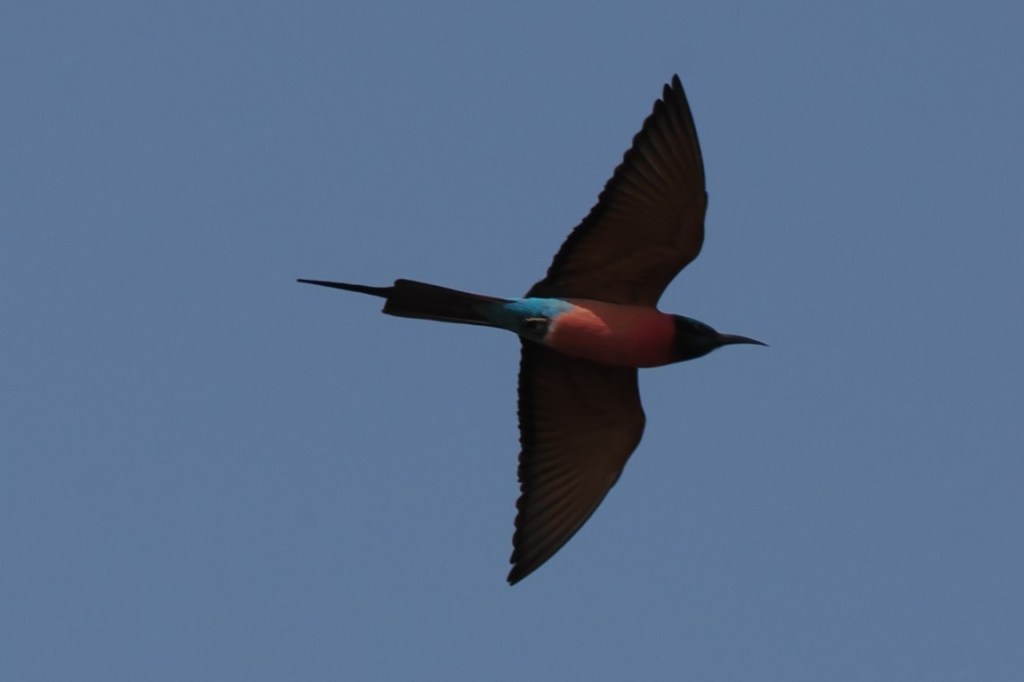
Breeding is colonial, with colonies typically established in steep sandy riverbanks, cliffs and similar exposures. Birds excavate long nesting tunnels into the bank, and large colonies can contain many hundreds of nesting pairs. Away from the breeding colony, flocks may range widely in search of suitable feeding areas.
Like other bee-eaters, the Northern Carmine Bee-eater feeds largely on flying insects, which are captured during graceful aerial sallies from a perch. One particularly characteristic behaviour is its habit of perching on the backs of large mammals and birds, using them as mobile vantage points from which to catch insects disturbed as the animals move through the vegetation. They may also follow vehicles, livestock and fires for the same reason.
The call is a low-pitched, rather raspy note, noticeably less musical than the calls of many other bee-eaters.
The species is very similar to the Southern Carmine Bee-eater (Merops nubicoides), although there is virtually no overlap between their normal ranges. Where identification is required, the Northern Carmine Bee-eater is readily distinguished by its blue-green throat, whereas the Southern Carmine Bee-eater has a predominantly carmine throat.
All photos from Gambia (c) Andrew P. Chick 2026



Leave a comment