The familiar Blackbird Turdus merula is one of Britain’s most recognisable garden birds. Adult males are normally almost entirely glossy black, with a bright yellow-orange bill and eye-ring, while females are predominantly dark brown. Occasionally, however, an individual appears with striking patches of white plumage. These unusual birds are generally described as leucistic Blackbirds.
Leucism is a condition in which the normal pigmentation of some or all of a bird’s feathers is reduced or absent. In Blackbirds it can vary enormously. Some individuals have only one or two white feathers, perhaps on the head or wings, while others develop extensive areas of white and black plumage. At the extreme, a leucistic bird may appear almost completely white.
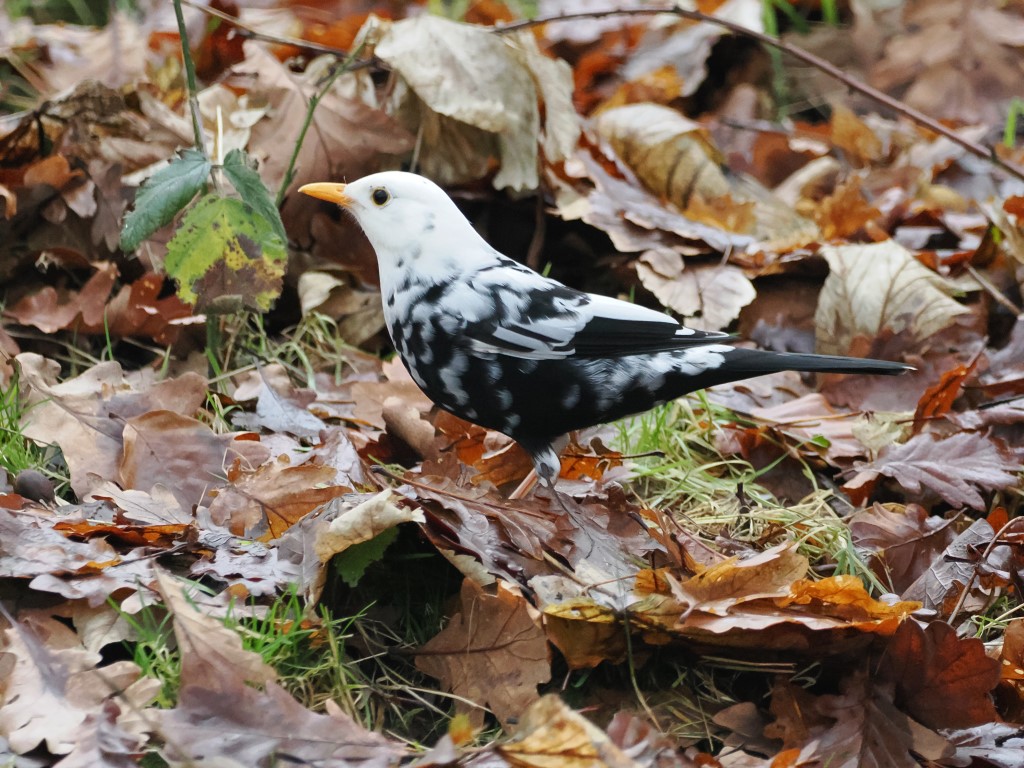
The bird pictured here is a particularly striking example. Much of the head is white, while the back, wings and underparts show an irregular mixture of black and white feathers. Importantly, the normally coloured eye and orange-yellow bill remain apparent – useful features when considering the difference between leucism and true albinism.
The photo was taken in Bowness, Cumbria in 2026 (c) Andrew P. Chick

Leucistic or Albino?
Although the terms are sometimes used interchangeably, leucism and albinism are different conditions.
Leucism involves a failure or reduction in the deposition of pigments in the feathers. It may affect individual feathers, patches of plumage or, more rarely, virtually the whole bird. The eyes, bill and bare skin are generally normally coloured because pigment remains present in these tissues.
Albinism, by contrast, results from an inability to produce melanin. A true albino bird therefore lacks melanin throughout its plumage and other tissues. The plumage is typically white and, most distinctively, the eyes appear pink or reddish because the absence of pigment allows the underlying blood vessels to show through. True albinism in wild birds is considerably rarer than leucism.
There are other causes of unusually pale plumage, so not every bird showing white feathers can automatically be diagnosed as leucistic from appearance alone. Nevertheless, the irregular black-and-white plumage frequently encountered in otherwise normal-looking Blackbirds is characteristic of leucism.
Why is it so noticeable in Blackbirds?
Leucism occurs in many bird species, but it is particularly conspicuous in species with normally dark plumage. Even a handful of white feathers stands out dramatically against the black plumage of a male Blackbird. Blackbirds are also extremely familiar birds that often live in gardens and parks, where individual birds may be observed repeatedly over several years.
Leucistic individuals generally behave just like normally plumaged Blackbirds, feeding amongst leaf litter, on lawns and beneath shrubs in search of earthworms, insects and other invertebrates, and taking berries and fruit when available. The unusual plumage does not make them a separate variety or subspecies – beneath the distinctive feathers they remain perfectly recognisable Blackbirds.
For the observer, however, encountering one can be memorable. With its almost pied appearance, the individual illustrated here demonstrates just how dramatic a relatively simple alteration in pigmentation can be, transforming one of our most familiar birds into something that looks, at first glance, remarkably unfamiliar.






Leave a Reply