
Tree lungwort (Lobaria pulmonaria) is a large and distinctive leafy lichen associated with old, humid woodlands. Once considerably more widespread, it has declined across much of Europe and is now particularly associated with areas where ancient trees, clean air and a long continuity of woodland habitat have survived.
Despite its plant-like appearance, tree lungwort is not a plant. Like other lichens, it is a complex partnership involving a fungus and photosynthetic organisms. In Lobaria pulmonaria, these include a green alga, while cyanobacteria are also present in specialised structures. This allows the lichen not only to produce energy through photosynthesis but also to fix atmospheric nitrogen, potentially contributing nutrients to the woodland ecosystem.
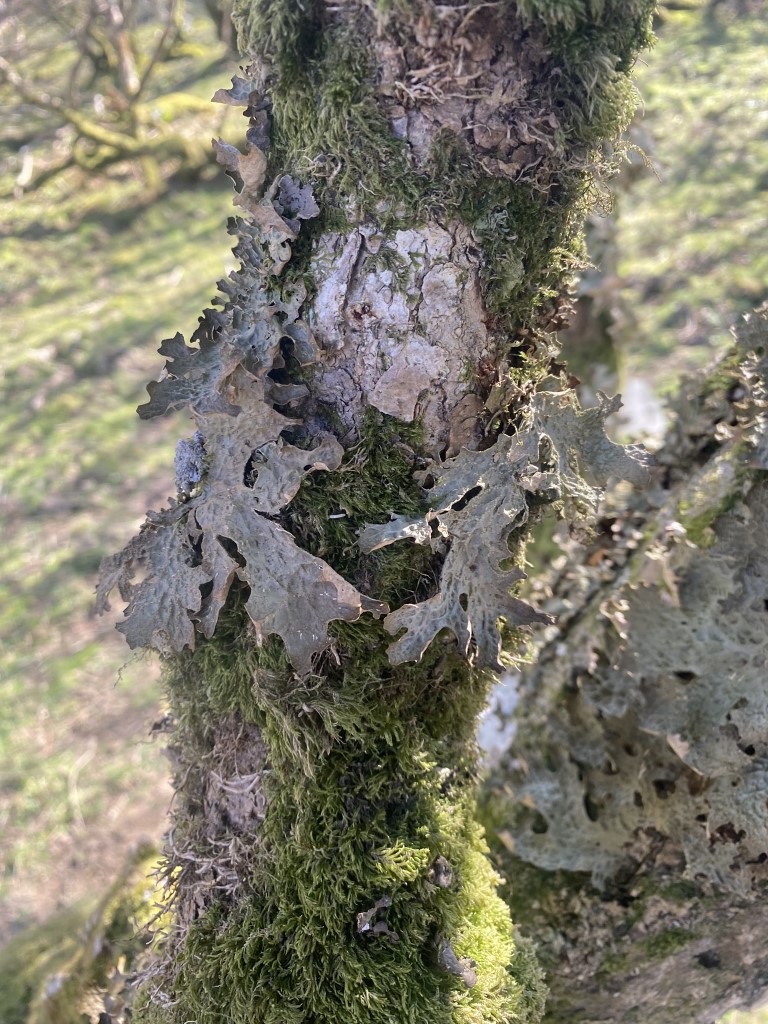
Tree lungwort forms large, leafy lobes that can create impressive patches across the trunks and branches of mature trees. When dry it is typically greyish or brownish-green, but after rain it becomes a much richer, brighter green. The upper surface has a conspicuous network of ridges and depressions which has been compared to the appearance of lung tissue — the origin of both its English name and the scientific name pulmonaria.
It grows mainly on the bark of mature broadleaved trees, particularly in old woodland with high humidity and relatively stable environmental conditions. Trees such as oak, ash, sycamore, willow and rowan can all support it, although the precise host varies according to locality and bark chemistry. It is especially characteristic of western oceanic woodlands, where high rainfall and moist air provide ideal conditions.
An indicator of important woodland
The presence of tree lungwort can be an indication of a woodland with a long history of ecological continuity. It belongs to a rich community of lichens, bryophytes and other organisms associated with old trees and ancient or long-established woodland. A tree supporting Lobaria pulmonaria may therefore be important not simply because of this single species, but because it can form part of a much wider assemblage of specialised woodland organisms.
Tree lungwort is sensitive to environmental change. Historically, air pollution — particularly sulphur dioxide — contributed substantially to its disappearance from many areas. Woodland clearance, the loss of veteran trees, changes in woodland management and breaks in habitat continuity have also been important. Even where air quality has subsequently improved, recolonisation can be slow because suitable habitat may be fragmented and the species does not necessarily disperse effectively over long distances.
Its survival therefore depends on maintaining both the trees on which existing colonies grow and a continuing supply of suitable trees nearby. Protecting only the individual host tree may not be enough: the surrounding woodland structure, humidity and future generations of mature trees are also important.
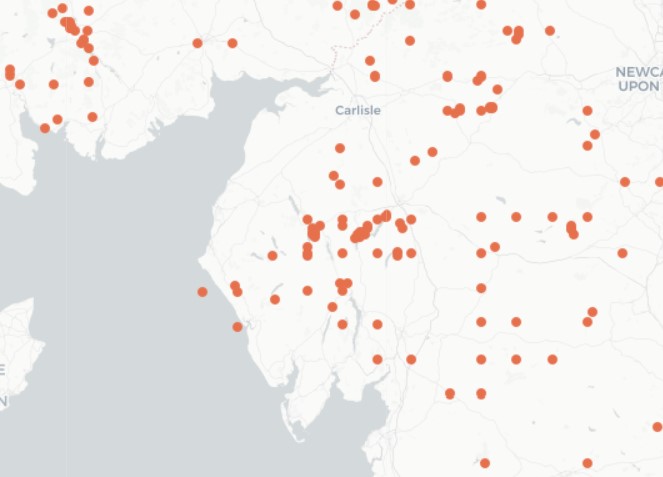
NBN Atlas for Lobaria pulmonaria showing distribution in Cumbria https://species.nbnatlas.org/species/NBNSYS0000019311
Tree lungwort in Cumbria
Cumbria lies within one of the most important parts of Britain for oceanic woodland lichens. The combination of high rainfall, relatively clean air and surviving areas of old woodland creates favourable conditions for Lobaria pulmonaria and many of its associated species.
Within the county it is most likely to be encountered in old, humid woodland, wooded valleys and places with mature or veteran trees, particularly in the wetter western parts of the Lake District. A well-developed colony spreading across an old tree trunk can be spectacular, especially after rain when the otherwise rather subdued thallus becomes a vivid leafy green.
Finding tree lungwort is also a reminder that an apparently ordinary old tree can support an extraordinary biological community. Such trees may have taken centuries to develop the conditions required by specialist lichens, making continuity of woodland and veteran-tree habitat particularly important.
For the naturalist, Lobaria pulmonaria is therefore much more than an attractive lichen. It is a species closely connected with old trees, clean air, humid woodland and ecological continuity — and one of the characteristic treasures of Britain’s surviving western woodlands.
Photographs (from Scotland) by (c) Andrew P. Chick 2025



Leave a Reply