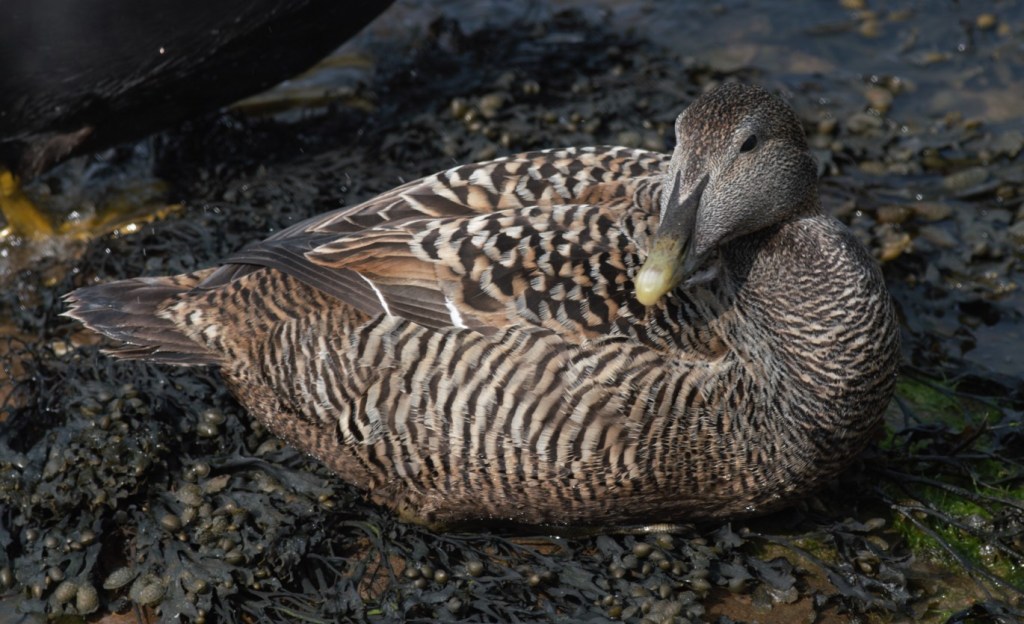
The Eider (Somateria mollissima) is one of our most distinctive seaducks, but its appearance can vary considerably according to sex, age and time of year. While the immaculate black-and-white adult drake is instantly recognisable, a flock of Eiders in late summer can contain a surprisingly confusing collection of brown, black, white and piebald birds.
The adult male in breeding plumage is unmistakable. The back and breast are predominantly white, contrasting strongly with the black belly, flanks and rear of the body. The head is largely white but has a black crown and striking pale green patches on the sides of the nape. A subtle pinkish flush can also be visible across the breast. Combined with the Eider’s characteristic long, wedge-shaped bill and sloping forehead, it makes the drake one of the most handsome ducks found around the British coast.
Females could hardly look more different. An adult female Eider is warm brown, intricately barred and streaked with darker markings. This is not simply less colourful plumage: it provides excellent camouflage when the female is sitting on her nest, often among rocks and low coastal vegetation. In flight, two paler wing-bars can usually be seen.
Things become particularly interesting during summer and early autumn. After breeding, adult males moult out of their familiar black-and-white appearance and enter eclipse plumage. At its most complete, this can make a drake appear surprisingly dark, predominantly blackish-brown, although varying amounts of white can remain on the wings and sides. During the transition, individuals can look decidedly untidy and quite unlike the classic Eider illustrated in a field guide.
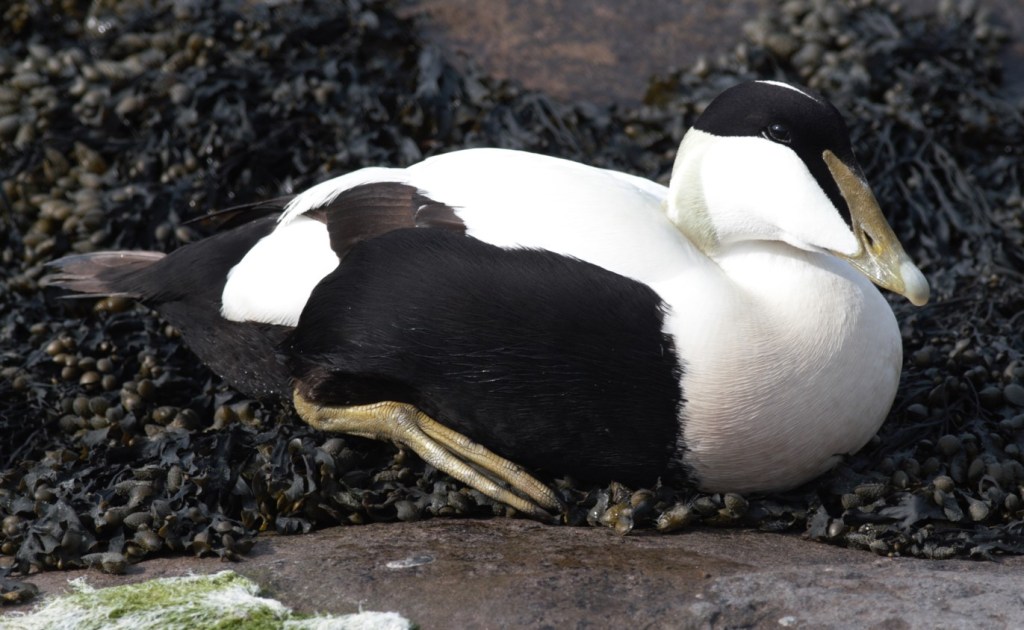
Young males add another complication. Juveniles initially resemble females, but as immature drakes gradually acquire their male plumage they develop an irregular mixture of dark and white feathers. Some become distinctly piebald, and the transition to the clean plumage of an adult male takes several moults.
This makes a late-summer flock of Eiders especially interesting to study. Alongside relatively uniform brown females may be juveniles, immature males in various stages of development and adult drakes passing through eclipse plumage. Rather than the simple collection of black-and-white males and brown females we associate with winter, almost every bird can seem slightly different.
By autumn and winter the transformation becomes apparent once again as the drakes regain their beautiful black-and-white plumage.
For anyone interested in bird identification, Eiders are therefore worth looking at carefully throughout the year. The same flock can provide an excellent lesson in age, sex and moult — and demonstrate just how dramatically a bird’s appearance can change with the seasons.




Leave a Reply