
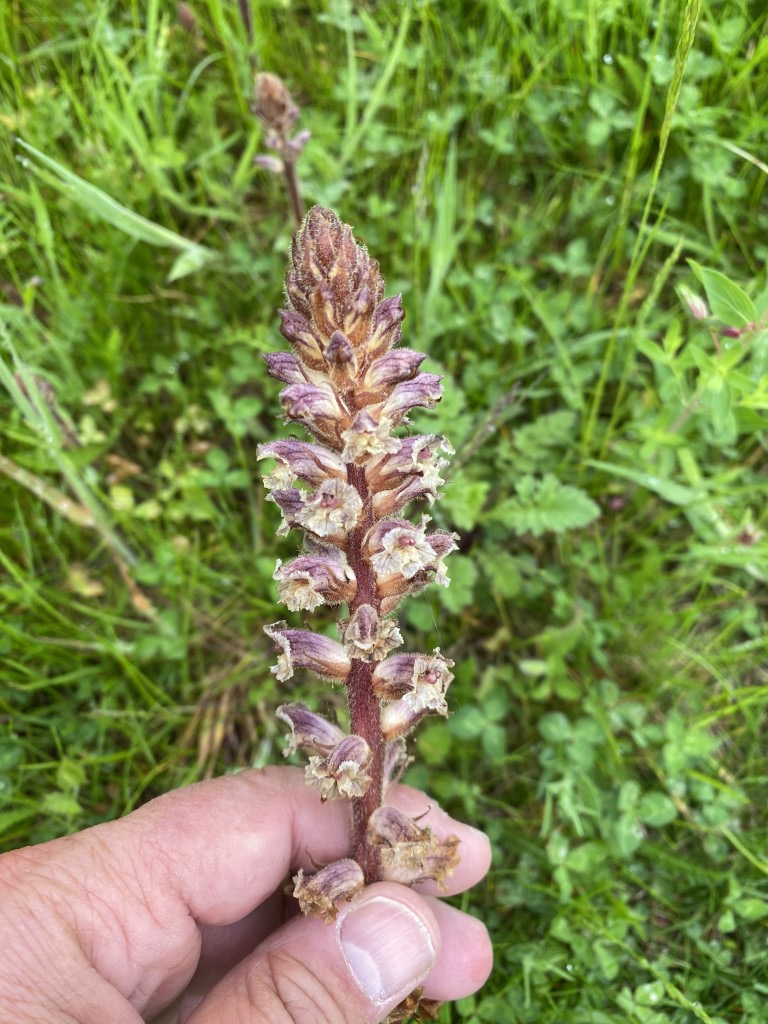
Broomrapes (Orobanche species) are among the strangest plants in the British flora. At first glance they can look more like fungi than flowering plants, with upright spikes of cream, yellow, brown or purplish flowers emerging directly from the ground. Most strikingly, they have no green leaves and virtually no chlorophyll.
The reason is simple: broomrapes don’t need to photosynthesise. Instead, they are entirely parasitic, obtaining water and nutrients from the roots of other plants.
A broomrape seed is extraordinarily small and can remain dormant in the soil for many years. Germination is triggered by chemical signals released from the roots of a suitable host plant. The young broomrape then attaches itself to the host’s root through a specialised structure called a haustorium, forming a connection through which it obtains everything it needs to grow.
For much of its life the plant remains completely hidden underground. Only when it is ready to flower does the characteristic spike emerge above the surface.
This dependence on particular host plants helps explain why broomrapes can have very local distributions. Different species specialise on different hosts. Common Broomrape (Orobanche minor), for example, parasitises a wide range of plants but is particularly associated with members of the pea family, including clovers. Other species are much more particular: Ivy Broomrape (Orobanche hederae) principally attacks Ivy, while Thyme Broomrape (Orobanche alba) is associated especially with Wild Thyme and other members of the mint family.
The name “broomrape” is ancient. The “broom” element refers to Broom, one of the plants upon which some species occur, while “rape” derives from an old word referring to a root or tuber rather than having its modern meaning.
Finding a broomrape is always rather special. They can appear suddenly in places where there was apparently nothing the previous year, sometimes forming impressive colonies before disappearing again. Their unusual appearance, specialised relationships with other plants and completely parasitic way of life make broomrapes some of the most fascinating flowering plants to encounter in Britain.



Leave a Reply