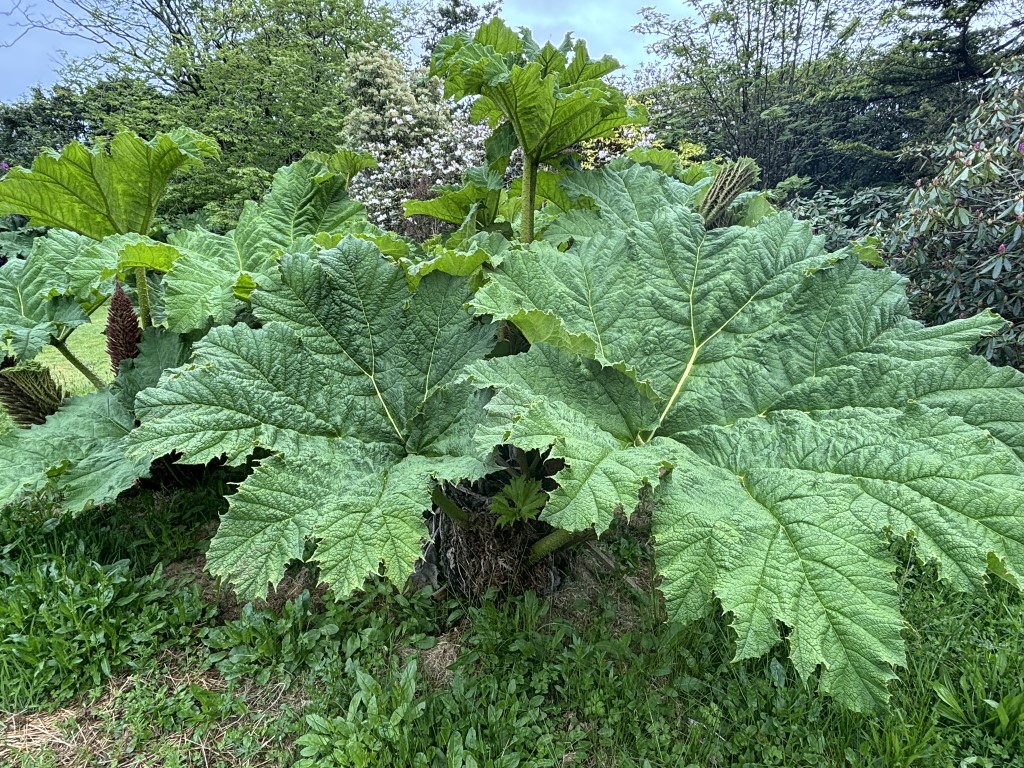
Few plants create as much impact in the landscape as Gunnera. Often referred to as giant rhubarb because of its enormous leaves, Gunnera is not related to culinary rhubarb but belongs to its own unique plant family. With leaves that can exceed two metres across and flower spikes reaching several metres in height, it is one of the most dramatic foliage plants grown in Britain.
Native to the cool, wet regions of South America, particularly Chile and Argentina, Gunnera thrives in damp conditions. It has long been a favourite of gardeners wanting to create a lush, tropical appearance around ponds, lakes and streams. During the Victorian era it became particularly fashionable in large country gardens, where its architectural leaves provided a striking contrast to more traditional planting schemes.
The most familiar species in Britain is Gunnera tinctoria, although Gunnera manicata has also been widely cultivated. Recent studies have shown that many plants sold as Gunnera manicata are actually hybrids between the two species. Regardless of their identity, these impressive plants produce huge, prickly leaves supported on thick stems armed with sharp spines. In summer they produce large cone-like flower spikes made up of thousands of tiny flowers, which are later followed by masses of small reddish fruits.
Growing Gunnera successfully requires plenty of moisture and rich soil. It performs best in full sun or partial shade where the ground remains consistently damp throughout the growing season. Although hardy in much of the UK, the enormous leaves are damaged by frost and die back in autumn. Gardeners often use the dead leaves as a natural mulch, folding them over the crown to provide protection through the winter before removing them in spring as new shoots emerge.
While admired for its spectacular appearance, Gunnera has become an environmental concern in several parts of Britain and Ireland. The species spreads readily by seed and can also regenerate from fragments of its crown. Once established, dense colonies can outcompete native vegetation, shading out smaller plants and altering the character of wetlands, riverbanks and coastal habitats. Its vigorous growth makes it particularly difficult to eradicate, with complete removal often requiring repeated treatment over several years.
Because of these ecological impacts, Gunnera tinctoria is now recognised as an invasive non-native species in the UK. It is illegal to plant it or allow it to spread into the wild, and gardeners are encouraged to dispose of unwanted material responsibly to prevent further colonisation of natural habitats. Conservation organisations across the country have undertaken programmes to remove invasive Gunnera from sensitive sites, helping to restore native plant communities.
Despite these concerns, Gunnera remains a fascinating plant. Few other species can rival its sheer size or its ability to transform a garden into something resembling a prehistoric rainforest. Where appropriate, and with careful management, it continues to be appreciated as one of the most impressive foliage plants ever introduced into British horticulture. At the same time, its story serves as a reminder that even the most beautiful ornamental plants can have significant ecological consequences when they escape cultivation.
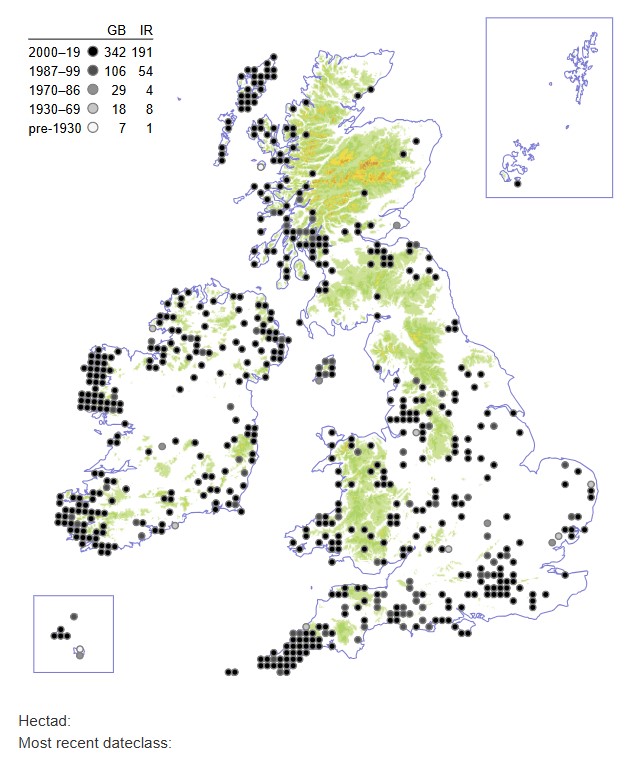
Although Gunnera is likley to be cultivated in a number of gardens across Cumbria, there are currently no known records of self-sustaining populations growing in the wild within the county. This contrasts with parts of western Britain, particularly western Scotland, Wales and south-west England, where invasive populations have become established in damp habitats. Cumbria’s cooler climate and the relatively limited planting of the species may have helped prevent its spread to date. Nevertheless, as Gunnera is capable of escaping cultivation under suitable conditions, any suspected wild populations should be recorded and, where appropriate, investigated to prevent future establishment.
The following map is taken from https://plantatlas2020.org/atlas/2cd4p9h.fbw an amazing resourse…. showing the UK distribution of Gunnera – just one ‘dot’ in Cumbria.



Leave a Reply