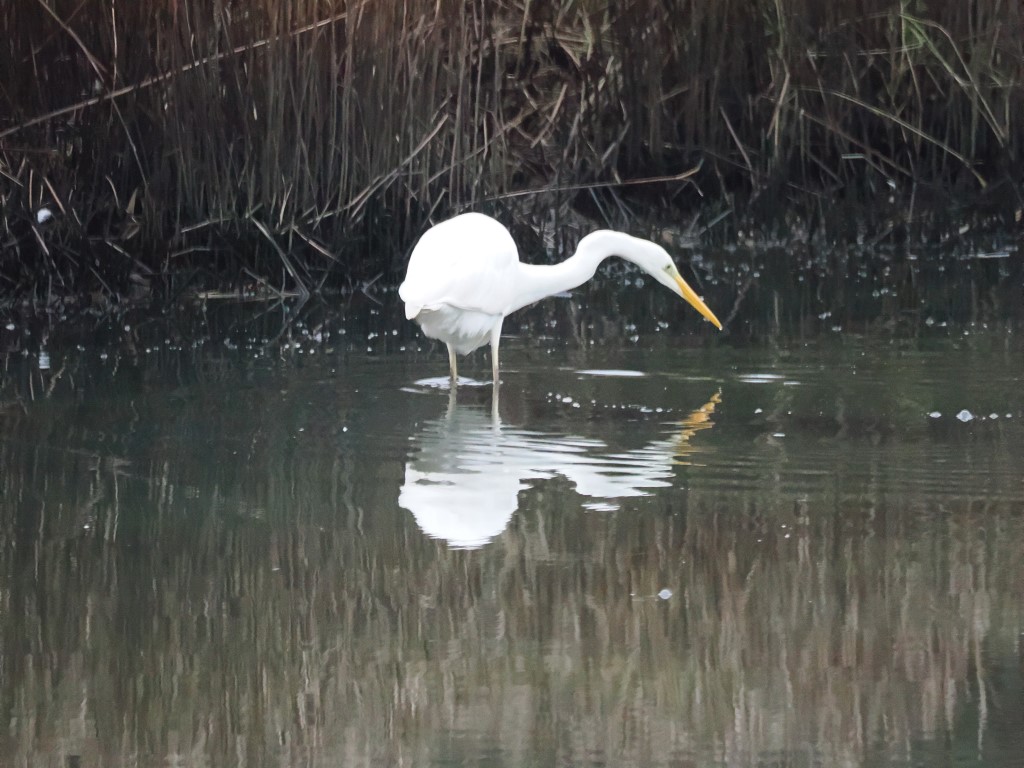
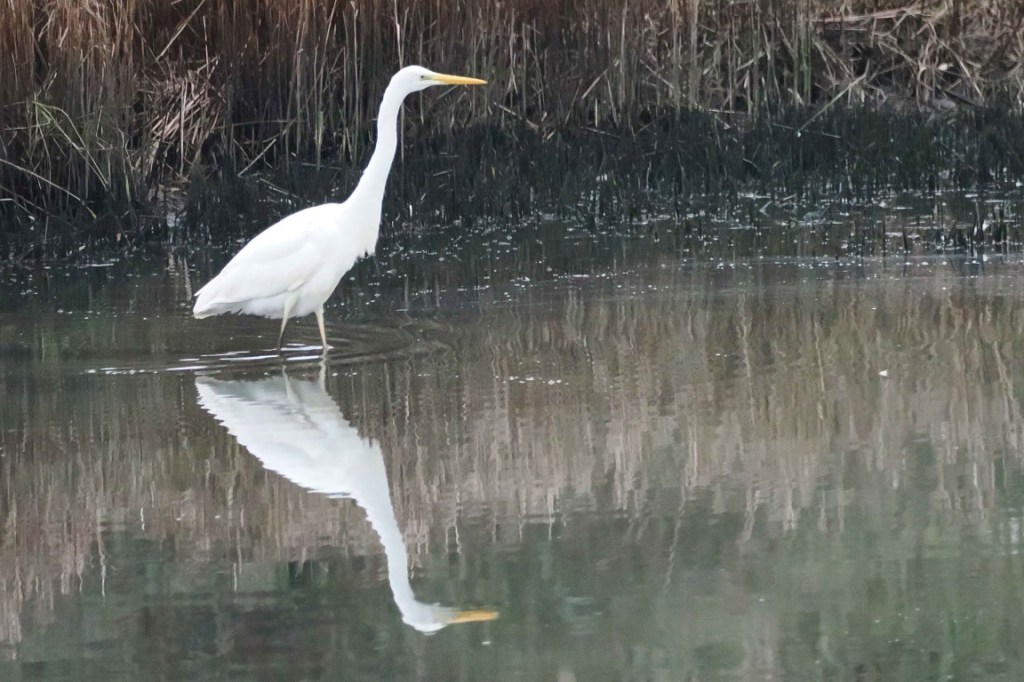
The Great White Egret has become one of Cumbria’s most remarkable avian success stories. Remarkably, the county’s first record was only as recently as 2003, yet in little over two decades the species has undergone a dramatic expansion. Once regarded as a genuine rarity, it is now becoming well established across the county, with birds present throughout much of the year. The increasing number of summer records also suggests that breeding is becoming established, with the first confirmed nesting likely to occur in the near future, if it has not already done so.
The current Cumbrian population appears to be centred on two principal coastal areas, one in the north of the county and the other in the south. By far the most important area is around the Kent Estuary, where Great White Egrets are now recorded throughout the year. During 2025, birds were reported from approximately 16 different sites around both the estuary and its surrounding wetlands. Many of these records almost certainly involved the same individuals moving between favoured feeding locations. The highest counts included three birds at Heversham Moss between 24th and 26th September, while the county’s largest gathering was eight birds on 1st October within the Kent Estuary area. Elsewhere along the southern coast, records were generally limited to single birds, although three were present at Sandgate Marsh on 11th September and two at Arnside Viaduct on 28th September.
Away from the coast, inland records continued to increase, illustrating the species’ ongoing expansion into the heart of Lakeland. Mere Tarn hosted a single bird intermittently from 10th to 13th May and again on 21st September. Sunbiggin Tarn proved to be one of the county’s most reliable inland sites, with a bird present from 2nd January until 1st April and again from 26th September through to 28th December. Longtown also emerged as an important locality, producing records of two birds on 19th March and an impressive four birds on 6th September.
Additional inland sightings came from a wide range of locations, demonstrating the increasing frequency with which Great White Egrets are encountered across Cumbria. Single birds were recorded along both the Rivers Eden and Eamont, while other notable observations included individuals at Geltsdale between 3rd and 6th January, Bassenthwaite on 1st April, Skelwith Bridge on 2nd October and Setterah Wetland, in the far north of the county, on 7th October.
The rapid spread of the Great White Egret mirrors the remarkable expansion seen across Britain over the last two decades. Increasing numbers, year-round occurrence and the establishment of regular summering birds all point towards the species becoming a familiar feature of Cumbria’s wetlands. What was once an exceptional rarity is now firmly establishing itself as one of the county’s most exciting and successful colonising waterbirds.



Leave a Reply