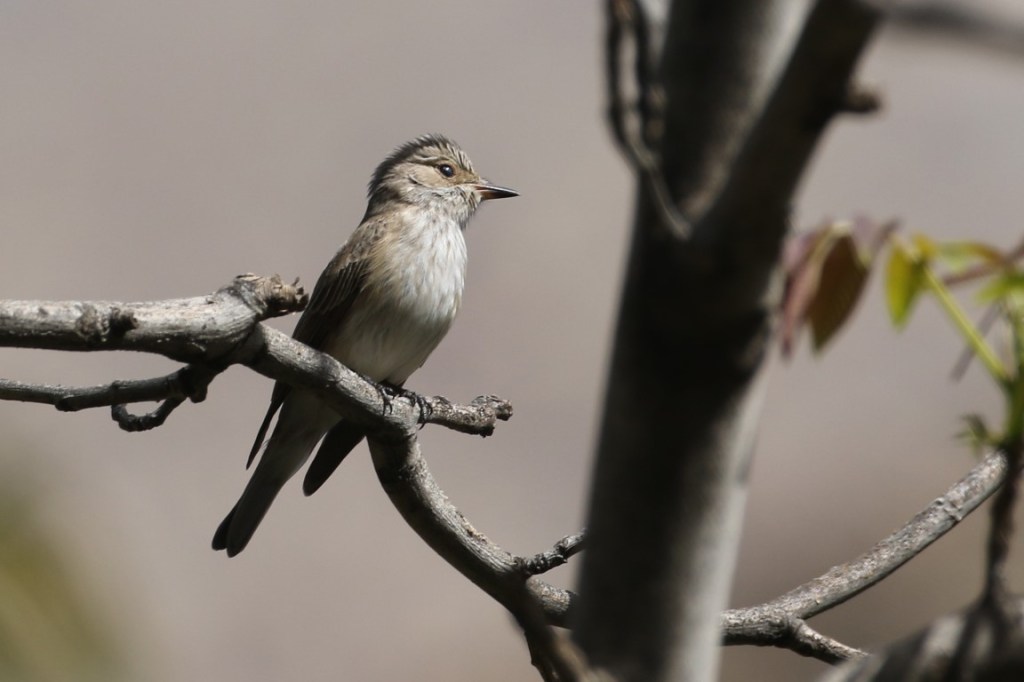
There was a time when the Spotted Flycatcher (Muscicapa striata) seemed almost an expected part of an English summer. Country gardens, village churchyards, farmyards, orchards and old houses regularly held a pair. A favourite fence post, gravestone or exposed branch would provide a hunting perch, from which the bird would repeatedly dart out after a passing insect before returning to almost exactly the same spot.
For many birdwatchers of an older generation, the Spotted Flycatcher is therefore a particularly poignant example of how much our countryside has changed. It hasn’t disappeared, but in many places where a pair was once simply taken for granted, seeing one today is a notable event.
The figures illustrate just how dramatic the change has been. BTO monitoring indicates that the UK breeding population has fallen by around 92% since the late 1960s, while in England numbers declined by 68% between 1995 and 2024. The species has been on the UK Red List since 1996.
The reasons are complex and are still not completely understood. Spotted Flycatchers are long-distance migrants, wintering in sub-Saharan Africa, so problems can occur not only on their English breeding grounds but also during migration and in Africa. Changes in the abundance of large flying insects, habitat change and poor survival have all been implicated. Recent research has also highlighted low breeding productivity in England, with gardens apparently providing better breeding conditions than farmland or woodland in some studies.
That association with gardens makes their decline seem particularly personal. The Spotted Flycatcher was never a brightly coloured or noisy bird. Its charm came from its unobtrusive presence: the upright grey-brown bird sitting on the same post each afternoon, the soft calls from an old apple tree, or a nest tucked onto a beam, climbing plant or sheltered ledge.
It was simply part of summer in the English countryside.
Perhaps that is why finding a pair today brings such pleasure. Watching a Spotted Flycatcher launch from a churchyard gravestone or the branch of an old fruit tree, twist effortlessly after an insect and return to its perch is a glimpse of something that was once commonplace.
The sad reality is that an ordinary bird of our parents’ and grandparents’ countryside has become an increasingly special bird of ours.



Leave a Reply