
The Grey Chi (Antitype chi) is one of those moths that feels particularly at home in the north-west of Britain. While many familiar garden moths are widespread throughout the country, Grey Chi has a distinctly northern and western distribution, with its British strongholds centred on northern England, north-west England, Wales and parts of Scotland.
This makes Cumbria particularly well placed for the species. Our combination of a cool, damp climate, upland grassland, moorland, rough pasture, rocky ground and traditional stone walls provides exactly the sort of conditions with which Grey Chi is associated. Nationally it is described as a predominantly northern species, commonest in central and north-west England and Wales, becoming much more local towards southern England.
A Sign That Autumn is Approaching
Grey Chi is very much a moth of late summer and early autumn. There is a single generation each year, with adults appearing principally during August and September. Although occasional individuals may occur outside this period, the great majority of records fall within these two months.
For anyone running a moth trap, its appearance is therefore one of those subtle signs that the season is changing. By August the great rush of high-summer moths is beginning to subside, nights are noticeably longer and species associated with the latter part of the year begin to appear. Grey Chi fits perfectly into this late-summer and early-autumn moth fauna.
In Cumbria it can begin appearing during the first half of August. Interestingly, the first Grey Chi reported through Butterfly Conservation’s Cumbria Branch sightings in 2026 was on 13 August, when one was found resting on a house wall at Stanwix, Carlisle.
Where Does the Name Come From?
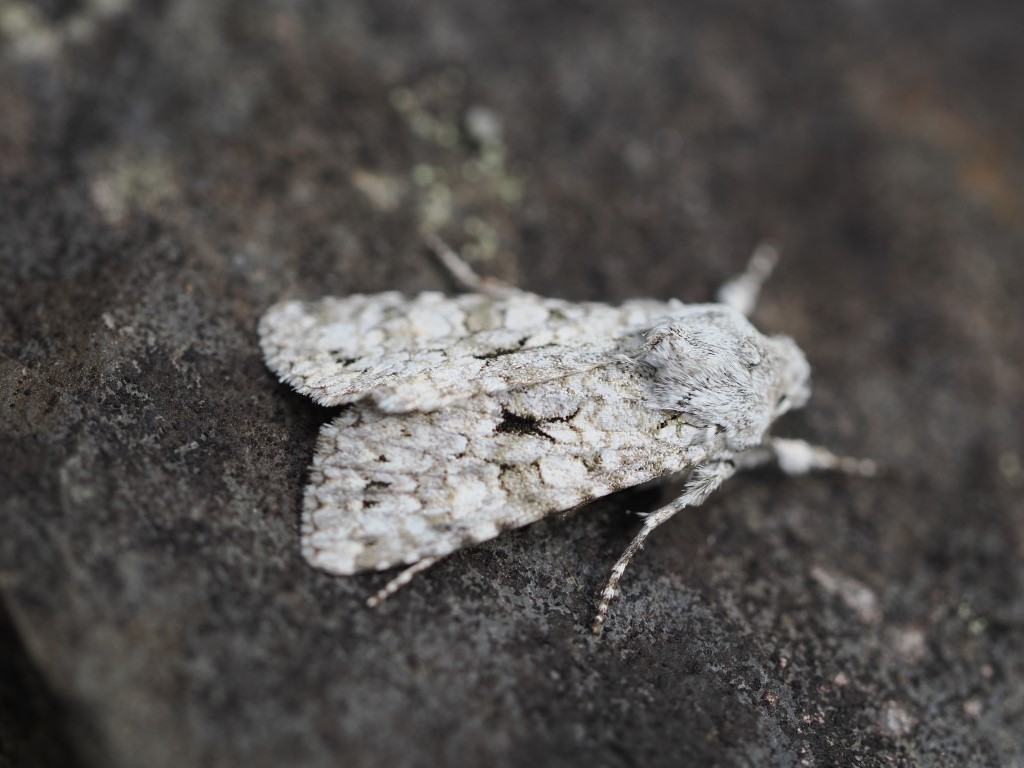
Grey Chi is a medium-sized noctuid moth, with a wingspan of around 32–37 mm. At first glance it can appear to be simply another rather grey moth, but closer examination reveals an intricately patterned insect.
The forewings are generally pale grey or whitish-grey, marked and mottled with darker grey and black. Most distinctive is a dark marking towards the centre of the forewing which has been compared with the Greek letter chi – Χ. It is this marking that gives the species its English name.
There is considerable variation between individuals. Some are remarkably pale and crisply marked, while others are considerably darker. Females tend to be more heavily marked than males.
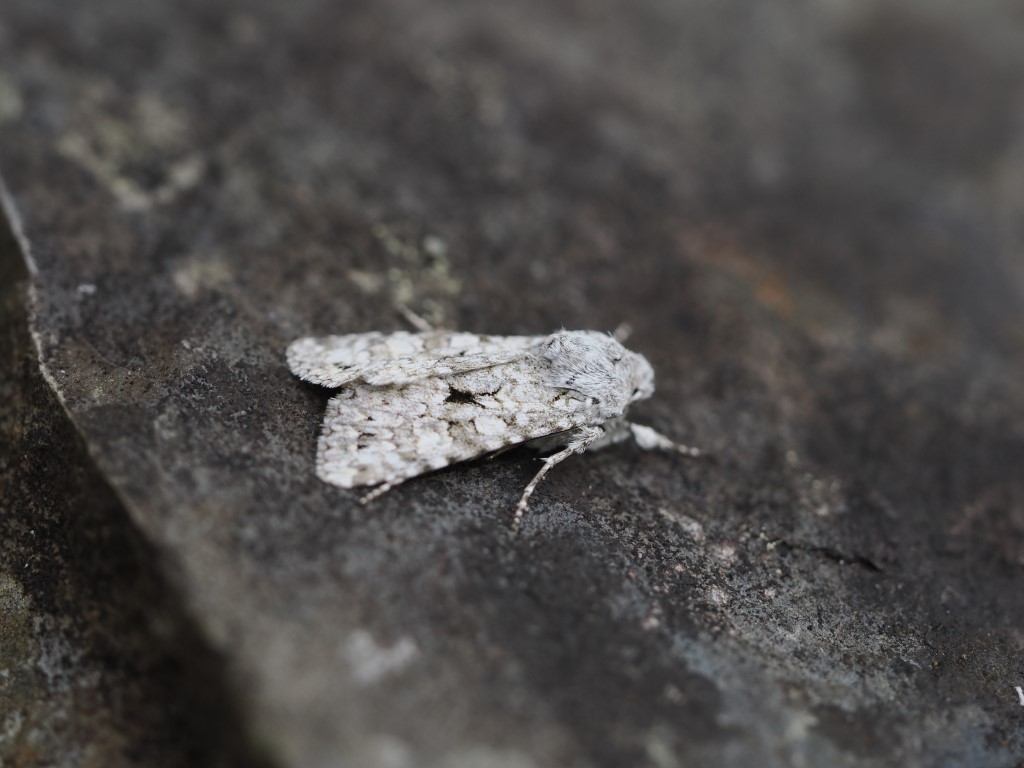
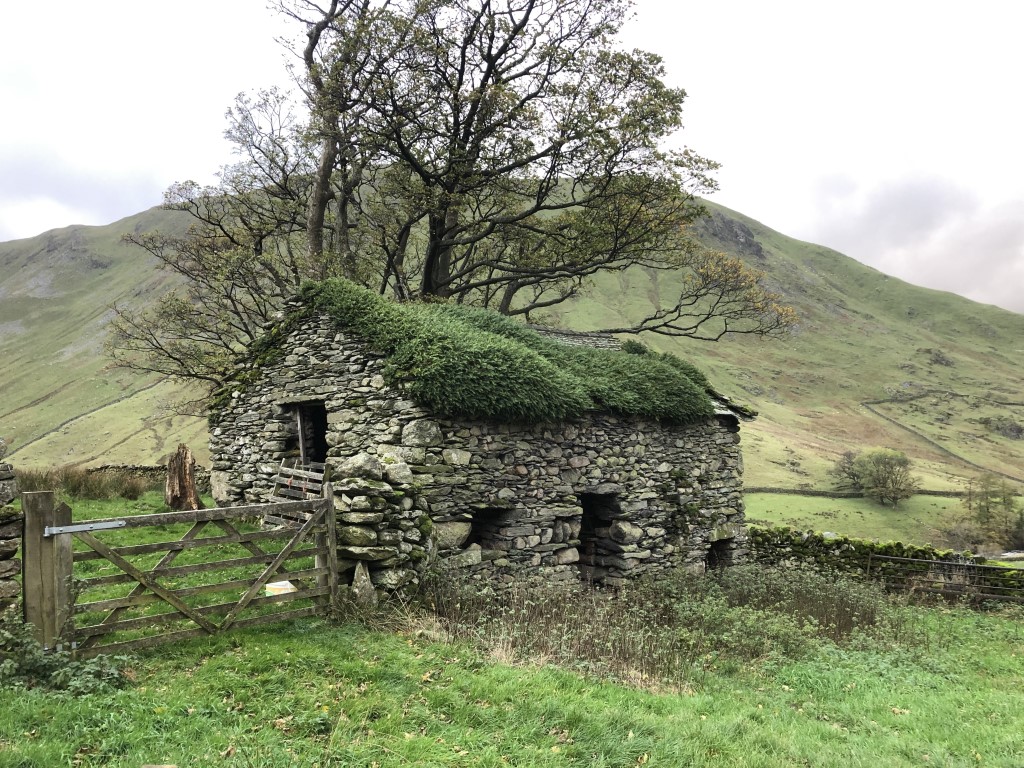
The colouring is also wonderfully effective camouflage. Grey Chi frequently rests during the day on rocks and stone walls, where its mixture of grey, black and whitish markings can make it extraordinarily difficult to see.
For a Cumbrian moth, that seems particularly appropriate – an insect whose camouflage is almost tailor-made for a landscape of grey rock, lichen and dry-stone walls.
A Moth of Hillsides and Moorland
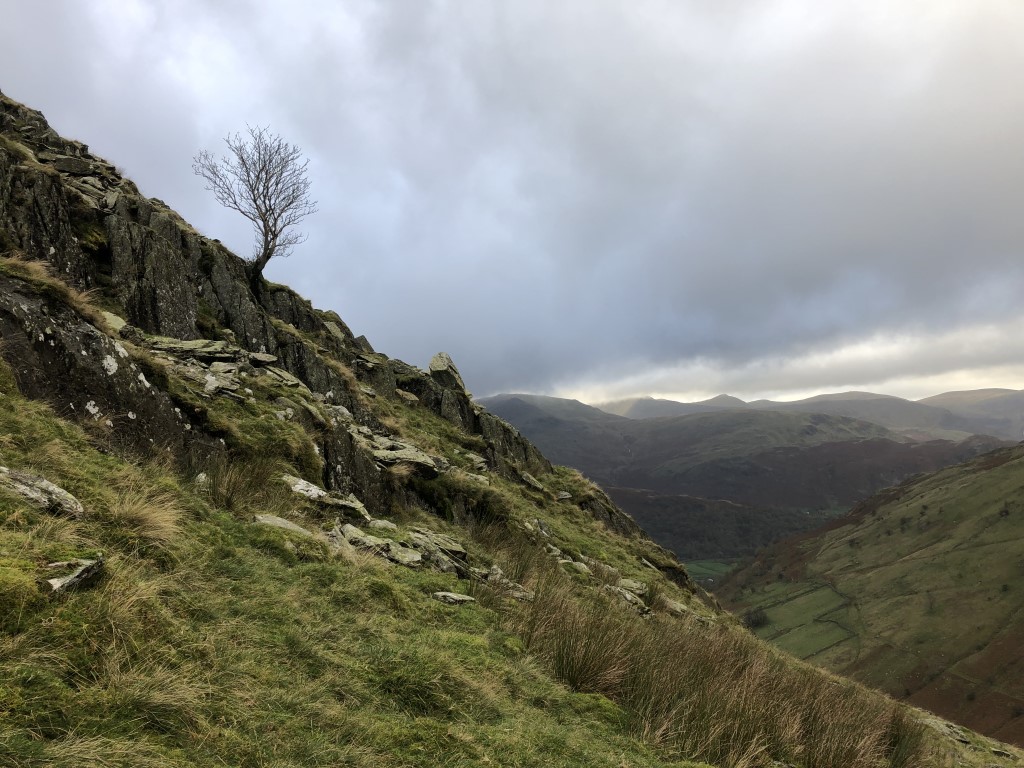
Although Grey Chi can turn up in gardens, particularly where moth traps are operated, its characteristic habitats are moorland, grassy hillsides and other open upland habitats.
This habitat preference helps explain its north-western distribution. Cumbria contains an enormous amount of potentially suitable habitat, from the valleys and rough pastures of the Lake District to the Pennine fringes and the extensive uplands of the north and east of the county.
It is not exclusively an upland moth, however, and individuals can occur at considerably lower elevations. Gardens, woodland edges and other semi-natural habitats can all produce records, particularly where they lie close to areas of suitable countryside.
Adults are nocturnal and readily attracted to light, which means the species is regularly encountered by moth recorders. During the daytime they may remain motionless on walls, rocks, fences or buildings, relying on their excellent camouflage.
The Caterpillar
Grey Chi spends much less of the year as the familiar adult moth than it does in its other life stages.
The species overwinters as an egg, with the caterpillars appearing subsequently and feeding on a wide range of plants. Rather than being dependent upon one particular foodplant, Grey Chi is relatively catholic in its tastes. The larvae feed on various low-growing plants and shrubs, and records include plants such as docks and a variety of shrubs.
This broad diet is another reason why suitable habitat can occur across a relatively wide range of Cumbrian landscapes.
After completing its larval development and pupating, the new generation of adults emerges towards the end of summer, and the cycle begins again.
Grey Chi in Cumbria
Grey Chi can still be regarded as a characteristic Cumbrian moth, rather than a great rarity. The Cumbria Moth Atlas was produced by the Cumbria Biodiversity Data Centre in conjunction with the Cumbria Moth Group, drawing together records from across the county to provide a detailed picture of the distribution of Cumbria’s larger moths.
Recent records also confirm that Grey Chi remains present in the county. The Cumbria Branch sightings database continues to receive reports of the species, including the Carlisle record in August 2026.
Its presence here is significant because Cumbria lies within the north-western core of the species’ British range. Travel south and east through England and Grey Chi generally becomes progressively more local, particularly towards southern and south-eastern England.
However, describing Grey Chi simply as a “common northern moth” hides a rather more worrying story.
A Northern Moth in Decline
Despite remaining widespread across parts of northern Britain, Grey Chi has undergone a substantial national decline.
The State of Britain’s Larger Moths 2021 reported a 57% decrease in the species’ British distribution between 1970 and 2016. Grey Chi was included amongst a suite of northern and western moths associated with cooler, damper conditions that have shown significant contractions in their ranges.
Earlier analysis had painted an equally concerning picture. The 2013 State of Britain’s Larger Moths report estimated that Grey Chi had suffered an 80% decrease in population over 40 years, with particularly steep declines after 2003. Importantly, those declines were not restricted to the southern edge of its range; reductions had also occurred in northern Britain.
There is evidence that climate may be playing a part. Grey Chi is one of several species associated with the cooler and damper north and west of Britain whose distributions appear to be contracting. In Yorkshire, for example, research found that Grey Chi had increasingly become confined to upland areas, with the average altitude of records moving progressively upwards.
That makes counties such as Cumbria increasingly important. Our extensive uplands and relatively cool, wet climate may provide something of a refuge for moths that are becoming less frequent farther south and at lower elevations.
One to Look for in August and September
For Cumbrian naturalists, Grey Chi is therefore an interesting species to record. It may not have the spectacular colours of some moths, but it is arguably much more representative of the landscape in which we live.
Look for it from August through September, particularly around upland and semi-upland habitats. It comes readily to moth traps, but it is also worth checking outside lights, walls and stonework in the morning. Its camouflage can be superb, so what initially looks like a small patch of lichen on a stone wall can occasionally turn out to have wings.
The appearance of the first Grey Chi of the year also marks a change in the moth-recording calendar. By the second half of August the nights are drawing in, summer is beginning to slip away and the first distinctly autumnal moths are appearing.
In Cumbria, Grey Chi is one of those species that signals the transition from summer into autumn – a beautifully camouflaged northern moth that remains characteristic of our part of Britain, but one whose national decline means that continuing to record it is increasingly important.



Leave a Reply